
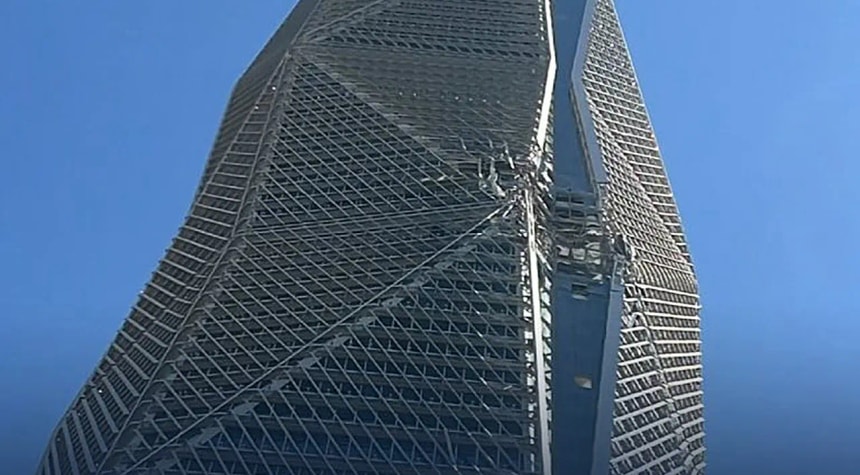
Iranian-backed Houthi forces struck the heart of Saudi Arabia’s financial district Thursday, damaging up to eight floors of the tallest skyscraper in Riyadh in what Saudi authorities are calling a terrorist attack. The 80-story Public Investment Fund Tower, which serves as headquarters for the Saudi sovereign wealth fund, sustained significant structural damage, though no casualties were reported.
The General Directorate of Saudi Civil Defense confirmed the attack on social media, stating that one of the towers in the King Abdullah Financial District was targeted by what they described as the terrorist Houthi militia. Windows were destroyed across multiple floors of the building, and portions of the metal facade were bent by the force of the impact. Authorities closed entrances to the financial district and evacuated personnel from the surrounding area as a precautionary measure.
This latest assault represents a troubling escalation in the Houthi campaign against Saudi Arabia’s economic infrastructure. The same financial district was targeted just weeks earlier on November 8, when Houthi forces attacked a building belonging to Aramco, the Saudi state-owned oil company. The pattern suggests a deliberate strategy to strike at the kingdom’s economic nerve centers.
Saudi air defenses demonstrated their capability Thursday by intercepting and destroying four ballistic missiles that were launched toward the southern region of the kingdom. Coalition spokesman Colonel Turki Al-Malki announced that Saudi forces then conducted offensive operations in Yemen, destroying a ballistic missile launch platform in Dhamar that had been used in the attempted attack on Riyadh.
The timing of these attacks is particularly significant. The Houthis have intensified their operations against Saudi Arabia amid the broader conflict between the United States and Iran. The militia, which receives substantial backing from Tehran, appears to be expanding its role as a proxy force in the region’s escalating tensions.
The United States Embassy and Consulates in Saudi Arabia issued a security warning to American citizens earlier this week, advising heightened vigilance due to the increased threat of armed attacks by Iranian-supported Houthis. The diplomatic mission specifically noted Iranian efforts to target American government officials and facilities throughout the region, cautioning that hostilities have the potential to escalate rapidly beyond their immediate area.
The attack on the Public Investment Fund Tower carries particular symbolic weight. The building houses one of the world’s largest sovereign wealth funds, which has become a central instrument of Saudi Arabia’s economic diversification strategy. Striking such a prominent landmark in the capital sends a message that extends beyond the immediate military considerations.
For the United States and its regional partners, the Houthi threat has evolved considerably beyond what was once primarily a local conflict in Yemen. The militia has demonstrated increasing technical capability with ballistic missiles and drones, along with a willingness to strike deep into Saudi territory. Intelligence assessments suggest that Iranian support has been instrumental in this expanded capacity.
The question now facing policymakers in Riyadh and Washington is how to respond to this escalating threat without triggering a wider regional conflict. Saudi Arabia’s military response in Yemen demonstrates a determination to degrade Houthi capabilities, but Thursday’s successful strike on Riyadh shows that defensive measures alone may prove insufficient. As tensions continue to rise across the Middle East, the attacks on Saudi Arabia’s financial district serve as a stark reminder that regional stability remains precarious, and that Iranian proxy forces have both the capability and the will to strike at the heart of American allies in the Gulf.
Related: TikTok Parent Company Seeks Half Billion Dollars in Microsoft AI Services Despite Security Concerns