
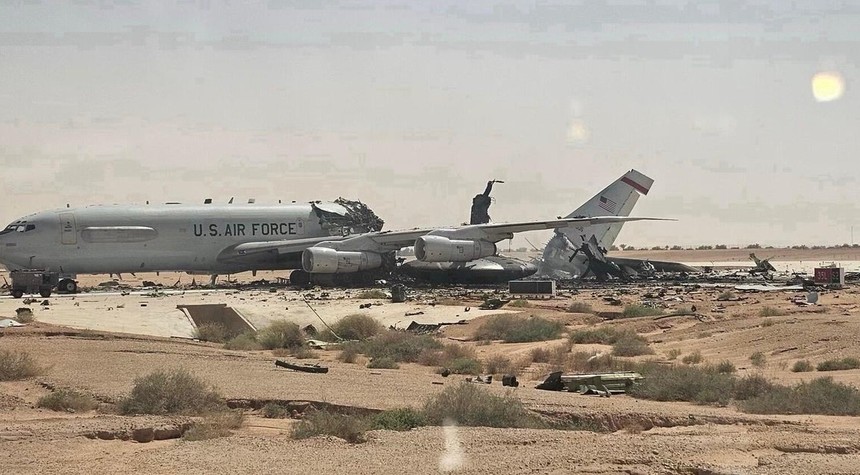
Newly obtained photographs provide the American public with its first comprehensive look at the extensive damage Iranian missile and drone attacks have inflicted upon United States military installations throughout the Middle East. The images, provided by active duty service members who requested anonymity due to military media restrictions, reveal a scope of destruction that has not been fully disclosed to the American people.
“This is major damage to our bases that hasn’t been communicated to the American public,” one deployed service member stated. “We’re standing there with our eyes closed getting punched in the face.”
The photographic evidence presents a troubling picture of America’s defensive posture in the region. At Prince Sultan Air Force Base in Saudi Arabia, one image captures the catastrophic results of a direct strike on a Boeing E-3 Sentry aircraft. The four-engine plane’s tail section was completely severed from its fuselage, which also housed the rotating radar system essential for midair intelligence collection. The charred remains of this critical asset underscore the precision and effectiveness of the Iranian offensive.
Additional photographs from the Saudi installation show buildings and barracks reduced to hollow shells. These structures stand in stark contrast to adjacent cement T-wall fortifications that remained intact. Once considered essential protection against grenade and mortar attacks, these barriers proved inadequate against aerial assault, a tactical reality that raises serious questions about American base defense strategies.
Similar devastation was documented at Camp Buehring in Kuwait, a crucial staging area for Army ground forces, armored vehicles, and aircraft. Located in the remote northwestern desert region far from Kuwait City, this installation serves as a vital logistics hub for American military operations in the theater.
The Defense Department’s inspector general released a report this week revealing equipment losses totaling approximately $3.7 billion, including nearly sixty aircraft. This unprecedented mandatory report to Congress disclosed that United States Central Command documented Iranian strikes at American bases across Kuwait, Bahrain, Qatar, the United Arab Emirates, Saudi Arabia, Iraq, Oman, and Jordan. The geographic spread of these attacks demonstrates the breadth of Iranian capabilities and the vulnerability of American positions throughout the region.
The Pentagon has not responded to requests for comment on these revelations.
The service member who provided the images disputed characterizations of the attacks as mere isolated incidents. “These are not ‘squirters’ getting through,” the individual stated, referencing language Defense Secretary Pete Hegseth employed following the deadly March 1 attack on the Port of Shuaiba in Kuwait that claimed six American lives. “We’re not defending these bases. We’re just watching them get destroyed.”
These photographs and the accompanying reports raise fundamental questions about American military readiness and defensive capabilities in an increasingly hostile Middle Eastern theater. The American people deserve a full accounting of the threat our service members face and the adequacy of the measures being taken to protect them and the billions of dollars in equipment entrusted to their care.
Related: Canada Seeks Economic Security Through Expanded Partnership with European Union