
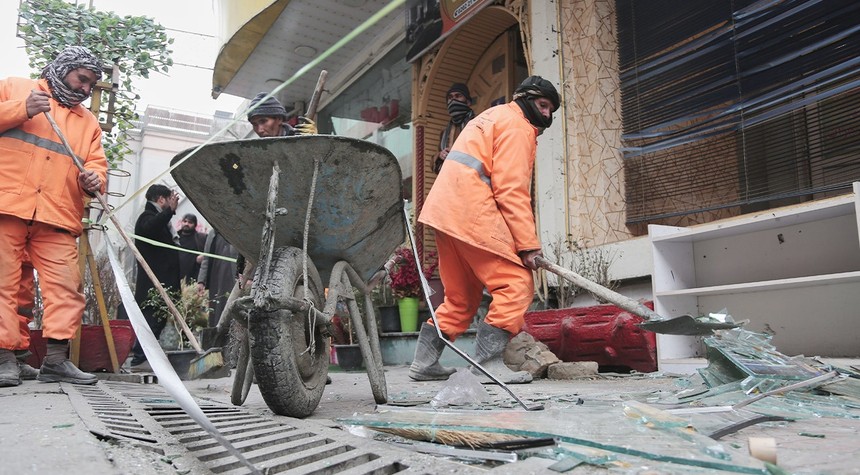
The Islamic State claimed responsibility Monday for a suicide bombing at a Chinese restaurant in Kabul that claimed the lives of more than seven individuals, including at least one Chinese national.
Abdul Mateen Qani, spokesman for the Afghan Interior Ministry, confirmed that the attack was executed by a single assailant connected to ISIS-Khorasan, the terrorist organization’s particularly lethal regional affiliate operating in Central and South Asia. The bombing represents the latest in a series of targeted strikes against Chinese interests in Afghanistan.
ISIS-K has publicly declared its targeting of Chinese citizens as retribution for Beijing’s documented treatment of Uyghur Muslims in western China’s Xinjiang province. The terrorist group has additionally condemned the Taliban government’s growing economic and diplomatic relationship with the People’s Republic of China.
The attack underscores the complex security landscape that has emerged in Afghanistan since the American withdrawal in August 2021. While the Taliban maintains nominal control over the country, ISIS-K has demonstrated its capacity to conduct sophisticated operations within urban centers, including the capital.
The relationship between China and Afghanistan’s Taliban government has grown increasingly significant in recent months. Beijing has pursued economic opportunities in Afghanistan, particularly regarding the nation’s substantial mineral deposits, while the Taliban seeks international legitimacy and investment. This partnership has made Chinese nationals and establishments attractive targets for ISIS-K, which views both the Taliban and Chinese government as adversaries.
The Uyghur situation in China has become a rallying point for various extremist organizations. Beijing’s policies in Xinjiang, which include what international observers have characterized as mass detention facilities and cultural suppression, have drawn widespread international criticism. ISIS-K has weaponized this issue in its propaganda, though the group’s actual concern for Uyghur welfare remains questionable given its own brutal tactics.
This attack arrives at a particularly sensitive moment for American immigration policy. Just this past week, Immigration and Customs Enforcement agents in Virginia arrested a third Afghan national who entered the United States during the Biden administration’s chaotic withdrawal from Afghanistan. These arrests have reignited debate regarding the vetting procedures employed during the emergency evacuation that brought tens of thousands of Afghans to American soil.
The security implications extend beyond Afghanistan’s borders. The persistence of ISIS-K operations demonstrates that terrorist organizations maintain operational capability despite years of counterterrorism efforts. The group’s ability to strike at will in Kabul raises questions about the Taliban’s capacity to provide basic security, let alone govern effectively.
For the international community, the incident serves as a stark reminder that Afghanistan remains a haven for terrorist activity. The vacuum created by the American departure has allowed groups like ISIS-K to operate with relative impunity, striking targets that align with their ideological objectives.
As workers cleaned the scene under Taliban police supervision Tuesday, the attack stands as evidence that the fundamental security challenges in Afghanistan remain unresolved. The convergence of regional power politics, religious extremism, and international terrorism continues to make Afghanistan a flashpoint with implications far beyond its borders.
Related: Global Markets Tumble as Trump Trade Threats Escalate Tensions with Europe