
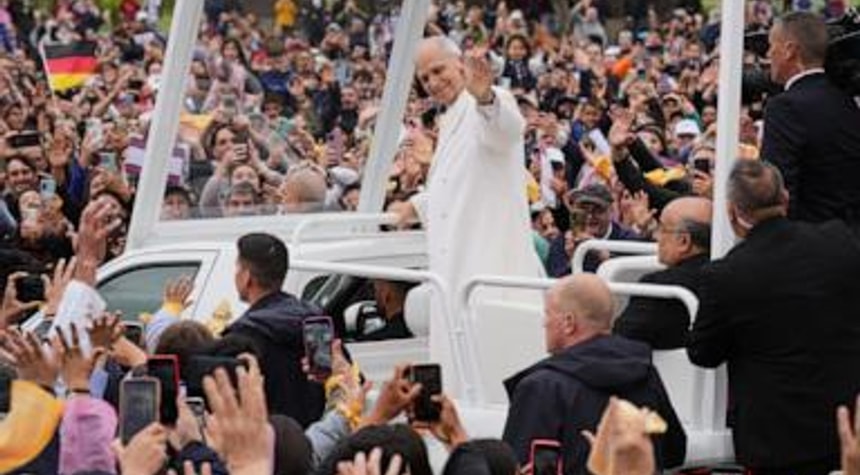
More than thirty thousand pilgrims gathered Saturday in the western Uruguayan city of Paysandú for what may prove to be one of the most significant pastoral visits in recent memory. Pope Leo XIV, just weeks removed from lung cancer surgery, celebrated Mass in a nation where religious indifference has become the prevailing cultural norm.
The symbolism was unmistakable. Here was a pontiff, physically diminished but spiritually resolute, bringing the message of the Catholic faith to a country that has largely turned away from it. Uruguay, with its population of three and a half million, stands as South America’s most secular nation. The Catholic Church here reported no new seminarians in 2024, though a handful have since entered formation.
Yet the faithful came nonetheless. They arrived from Uruguay, Argentina, and Brazil, streaming through the gates of Parque París Londres before dawn. Many wore rain ponchos in the Vatican’s yellow and white. A band played Spanish hymns as the crowds assembled in the sprawling green space on Paysandú’s southern edge.
Soledad Sánchez, seventy-three, had driven from northern Uruguay to witness the historic occasion. She fought back tears as she spoke of the Pope’s determination to continue his twelve-day South American tour despite his October cancer diagnosis. The pontiff’s commitment to press forward, she said, demonstrated exactly the kind of leadership a troubled world requires.
Paysandú, located approximately two hundred thirty miles from the capital Montevideo, has never hosted a papal visit. The city sits on the Uruguay River, connected by bridge to the Argentine city of Colón. This geographic positioning made the Mass more accessible to many Argentines than any stop on the Pope’s upcoming Argentine itinerary, which includes Buenos Aires, Luján, and Córdoba.
The disparity in religious culture between the two nations could not be more pronounced. Argentina remains a deeply Catholic country, while Uruguay has systematically separated itself from religious tradition. Yet young Catholics in Uruguay see potential for renewal. Teresa Sabellini, an eighteen-year-old from Paysandú, observed that many of her peers are actively seeking meaning and community through faith, contrary to the prevailing narrative about Uruguayan secularism.
The Pope’s message has been consistent throughout this journey. At Friday evening vespers in Montevideo’s cathedral, he acknowledged that many Uruguayans know little of their Catholic heritage, despite the Church’s integral role in the nation’s independence and formation. He urged clergy to model themselves on Christ, suggesting that genuine witness carries special power in a land where young people have grown up distant from the Church.
Saturday’s schedule reflected the Pope’s emphasis on confronting contemporary challenges through faith. Following the morning Mass, the pontiff planned to tour a Montevideo neighborhood plagued by drug trafficking and gang violence, where the Church collaborates with municipal authorities on housing construction and addiction rehabilitation programs. A prayer vigil at Montevideo’s Centenary Stadium would conclude the day.
The Mass itself honored Blessed Jacinto Vera, a nineteenth-century priest who became Uruguay’s first bishop. The Pope praised Vera’s pastoral work among the poor, describing him as a man in whom others found Christ’s goodness even before hearing his sermons.
Not everyone in attendance identified as particularly religious. Santiago Biglieri, an eighteen-year-old Colombian resident of Uruguay, acknowledged he would not call himself devout but found the Pope’s humanitarian message compelling regardless of one’s faith commitment.
The city of Paysandú itself remained relatively subdued, with minimal decorations and few Vatican flags visible on homes. The muted response perhaps best illustrates the challenge facing the Church in Uruguay.
After completing his Uruguayan visit, Pope Leo XIV will proceed to Argentina before concluding his tour in Peru, described as his second homeland. The ambitious three-nation journey represents a calculated gamble by a pontiff determined to fulfill his pastoral duties despite serious health concerns.
Whether this visit will meaningfully alter Uruguay’s secular trajectory remains uncertain. What cannot be disputed is the Pope’s willingness to meet the challenge directly, bringing his message to one of the least receptive audiences in the Western Hemisphere. In an age of carefully managed public appearances and risk-averse leadership, such determination merits acknowledgment regardless of one’s religious convictions.
Related: Pope Leo XIV Defends Voting Rights After Casting Ballot from Vatican