
A significant bipartisan coalition in the United States Senate has issued a formal challenge to President Donald Trump’s recently announced diesel agreement with Russia, raising concerns that the arrangement may provide material support to Moscow’s ongoing military operations in Ukraine while offering minimal benefit to American consumers.
The senators, representing both sides of the political aisle, have directed their objections to the Treasury Department’s General License No. 135, which effectively lifts sanctions on Russian diesel exports. Their concerns center on the strategic implications of providing the Kremlin with additional revenue streams during a period of active conflict in Eastern Europe.
The congressional letter articulates a straightforward argument: lifting sanctions on Russian diesel exports will generate substantial revenue for Moscow while providing negligible relief to American families facing high energy costs. The senators assert that these funds will inevitably support Russia’s military capabilities and strengthen its security cooperation with China, Iran, and North Korea.
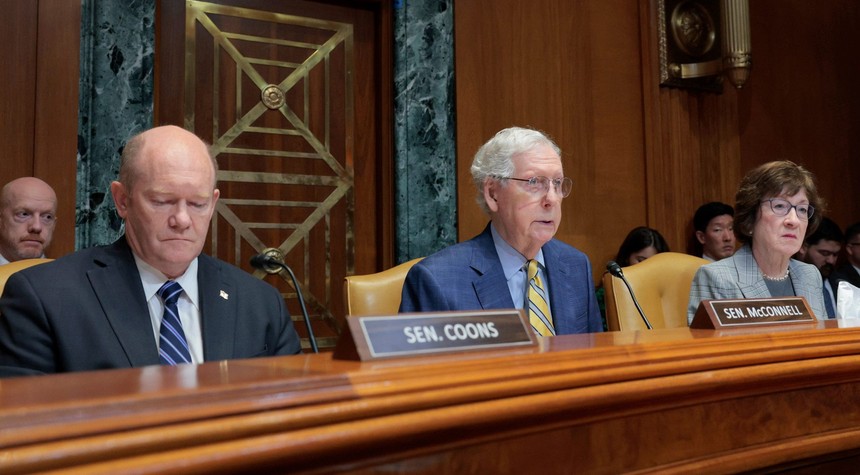
The bipartisan nature of this opposition bears particular significance. Republican senators Mitch McConnell of Kentucky, Susan Collins of Maine, Thom Tillis of North Carolina, Lisa Murkowski of Alaska, and John Cornyn of Texas have joined Democratic senators Richard Blumenthal of Connecticut, Jeanne Shaheen of New Hampshire, Dick Durbin of Illinois, Sheldon Whitehouse of Rhode Island, Jack Reed of Rhode Island, and Chris Coons of Delaware in signing the formal objection.
This alliance represents a notable fracture within Republican ranks regarding the administration’s approach to Russia policy. The senators explicitly acknowledge the Trump administration’s stated objective of lowering energy costs for American families, particularly in light of disruptions caused by ongoing conflict with Iran. However, they contend that the Russian diesel agreement represents a flawed strategy that sacrifices strategic interests for minimal economic gain.
The senators further warn that the agreement endangers American servicemembers operating overseas in support of Operation Epic Fury. Their letter calls for the administration to withdraw from the agreement, rescind General License No. 135, and instead execute authorities provided under the Lindsey O. Graham Sanctioning Russia and Iran Act of 2026.
The congressional opposition frames the issue in stark moral terms, characterizing Russian President Vladimir Putin as a tyrant and describing the diesel agreement as both a gift to an adversary and a betrayal of allied nations, particularly Ukraine, which continues to defend itself against Russian military aggression.
The letter was formally transmitted to both Treasury Secretary Scott Bessent and Secretary of State Marco Rubio, indicating that the senators expect a coordinated policy response from the administration’s economic and diplomatic leadership.
This development illustrates the complex intersection of domestic energy policy, international security commitments, and alliance management that confronts American policymakers. The question now becomes whether the administration will maintain its current course or respond to this substantial congressional pressure.
The Senate coalition’s invocation of America’s role as leader of the free world represents an appeal to traditional post-World War II American foreign policy principles, suggesting that some lawmakers believe fundamental aspects of that leadership are at stake in the administration’s approach to Russia.
Related: United States Accelerates Hypersonic Weapons Development Despite Soaring Costs