
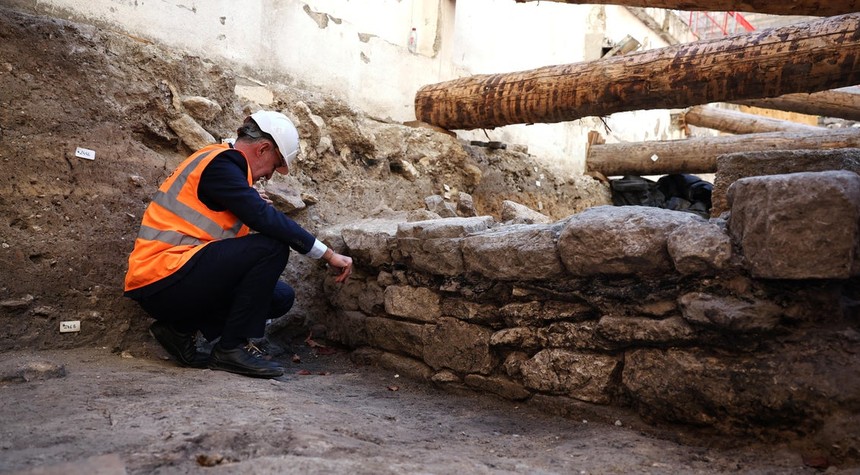
Archaeological investigators working beneath a hotel on the Île de la Cité in Paris have uncovered what may prove to be one of the most significant discoveries in the study of the city’s ancient origins. The stone-and-wood wall, measuring approximately 65 feet in length and dating from the Gallo-Roman period, was found this summer and represents what France’s culture ministry has described as a major breakthrough in understanding the earliest days of the French capital.
The discovery carries particular weight because it may finally settle a longstanding debate among historians and archaeologists about the precise location of Lutetia, the ancient settlement that would eventually become Paris. The wall is believed to be a remnant of the fortifications built by the Gallic Parisii tribe, who inhabited the region along the river Seine during the Iron Age.
For generations, scholars have accepted the Île de la Cité as the heart of ancient Lutetia. However, competing archaeological evidence has suggested that the original settlement may have been located in Nanterre, a suburb to the west of modern Paris. This new discovery, found mere steps from Notre Dame Cathedral, lends considerable weight to the traditional interpretation.
Culture Minister Catherine Pegard acknowledged the significance of the find while maintaining appropriate scientific caution. The convergence of evidence appears particularly remarkable at this stage of analysis, though researchers must still verify the wall’s specific function and establish a more precise chronology.
The historical importance of this discovery cannot be overstated. Lutetia first entered the written record in the seventh book of Julius Caesar’s “Gallic Wars,” where the Roman leader described it as situated on an island in the Seine. That vague geographical description has fueled centuries of scholarly debate and speculation.
What makes this discovery especially compelling is the physical evidence it bears. The wall shows distinct traces of fire damage, which may correspond directly to Caesar’s own account of the Battle of Lutetia. According to Roman records, the Gauls deliberately set fire to their town before engaging Roman forces in combat in 52 B.C.
Carbon dating analysis of the charred remains indicates the wall dates from somewhere between 10 and 200 B.C., a timeframe that encompasses the Battle of Lutetia. This scientific evidence, combined with the archaeological context and historical records, creates a persuasive case for the wall’s connection to that pivotal moment in the region’s history.
The Île de la Cité, where the wall was discovered, is the largest island in the Seine within the Paris region and served as the nucleus of the Roman settlement that followed the Gallic period. The island has proven to be an archaeological treasure trove in recent years. Notre Dame Cathedral itself has yielded numerous significant finds, including a fourth-century coin and enigmatic inscriptions discovered in June, as well as several tombs and a sarcophagus dating from the 14th century that were unearthed in 2022.
This latest discovery arrives less than a year after another remarkable find along France’s coastline, where a massive prehistoric stone wall was located in the waters off the Île de Sein.
As excavation and analysis continue, researchers will work to confirm the wall’s exact purpose and refine its dating. If their preliminary assessments prove accurate, this discovery will represent a major advancement in our understanding of Gallic Lutetia and the origins of one of the world’s great cities.
Related: Chinese President Xi Jinping Arrives in Washington for High-Stakes Summit with Trump