
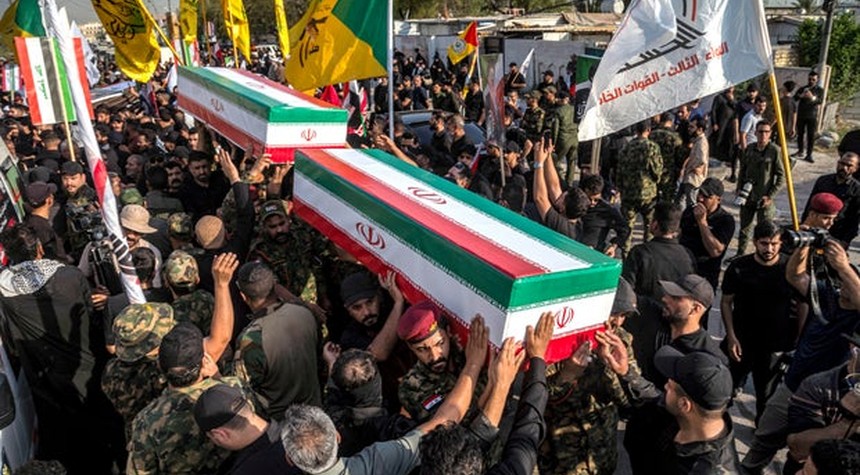
Iran has confirmed the return of five Islamic Revolutionary Guard Corps members killed during coordinated American and Saudi military operations in Iraq earlier this week, marking another escalation in the ongoing shadow conflict between Tehran and Washington across the Middle East.
The bodies crossed into Iranian territory through the Mehran border crossing in western Ilam province, according to Iranian state media reports released Friday. The five Guards members were among at least twenty militants killed when American and Saudi forces struck positions belonging to the Hashed al-Shaabi, an Iraqi armed coalition that includes several powerful groups aligned with Iranian interests.
The United States and Saudi Arabia announced Wednesday that the strikes were conducted in direct response to recent attacks on the Gulf kingdom. The operation represents a notable development in regional security dynamics, particularly given the direct Saudi participation alongside American forces. This joint action signals a coordinated approach to countering Iranian-backed militant activities that have increasingly threatened stability in Iraq and the broader region.
The Islamic Revolutionary Guard Corps’ Quds Force, which oversees Tehran’s military and intelligence operations beyond Iranian borders, has long served as the primary instrument of Iranian influence throughout the Middle East. Guards members killed outside Iran are typically affiliated with this specialized unit, which has established extensive networks of proxy forces across Iraq, Syria, Lebanon, and Yemen.
The current situation bears uncomfortable echoes of January 2020, when American forces killed Qasem Soleimani, the commander of the Quds Force, in a targeted airstrike near Baghdad International Airport. That operation brought the United States and Iran to the brink of direct military confrontation, with Tehran responding by launching ballistic missiles at American military installations in Iraq.
The Hashed al-Shaabi, officially incorporated into Iraq’s security forces, has presented persistent challenges for American policy in the region. While the coalition played a significant role in defeating the Islamic State, several of its component militias maintain closer allegiance to Tehran than to Baghdad. This divided loyalty has complicated efforts to establish Iraqi sovereignty and reduce foreign influence in the country’s internal affairs.
The strikes and subsequent recovery of Iranian casualties underscore the delicate balance of power in Iraq, where American forces maintain a presence focused on preventing an Islamic State resurgence while simultaneously confronting Iranian attempts to expand regional influence. Baghdad finds itself caught between these competing interests, struggling to assert independence while managing relationships with both Washington and Tehran.
For the Saudi kingdom, direct participation in strikes against Iranian-backed forces represents a willingness to take more assertive action against threats emanating from groups supported by its primary regional rival. Recent attacks on Saudi territory have tested the kingdom’s patience and prompted calls for stronger responses to deter future aggression.
The return of these five Revolutionary Guards members to Iran will likely be accompanied by funeral ceremonies that serve both as memorial services and demonstrations of Iranian resolve. Tehran has historically used such occasions to reinforce its commitment to regional activities, despite the human cost and international pressure.
As tensions continue to simmer across the Middle East, the fundamental questions remain unchanged: whether diplomatic efforts can establish acceptable boundaries for Iranian regional activities, and whether military responses to proxy attacks will deter or escalate the conflict. The answers will significantly shape regional stability in the months ahead.
Related: French Wildfires Threaten Bordeaux Wine Industry as Evacuations Continue