
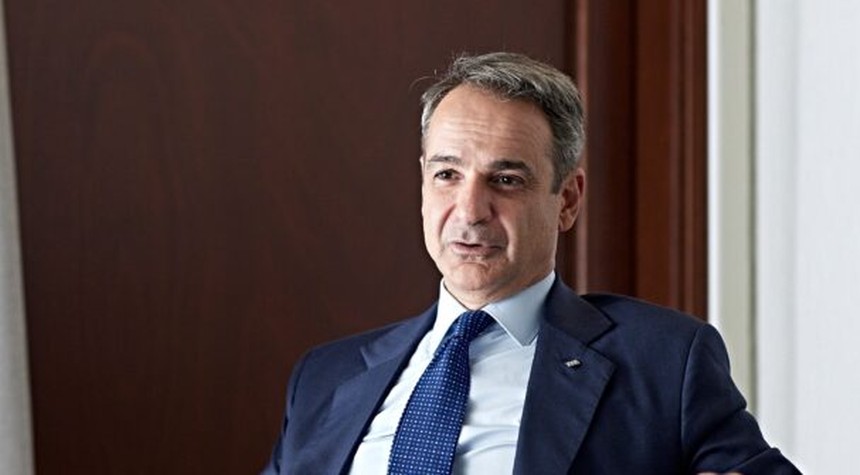
DELPHI, Greece — In the mountainous region of central Greece where ancient oracles once spoke, a modern European leader has voiced his hopes for peace in the Middle East and stability in global energy markets.
Greek Prime Minister Kyriakos Mitsotakis, speaking from the sidelines of the annual Delphi Economic Forum, expressed his support for American efforts to reach a diplomatic agreement with Iran. The Greek leader’s concerns center on the economic disruption caused by recent hostilities and the urgent need to restore normal operations through the Strait of Hormuz, a critical chokepoint for global oil shipments.
“Let’s hope that we will also have some sort of agreement regarding the situation in the Middle East because of course we’re all quite concerned about the economic fallout,” Mitsotakis stated. “Of course, we, from the very beginning, said that Iran cannot have a nuclear weapon, and as a country in the region we’re always very concerned with the destabilizing effect that Iran had but I think we’ve reached a point where we need to be quite concerned about the economic fallout of this situation.”
The Greek prime minister’s comments come at a pivotal moment in American-Iranian relations. An initial two-week ceasefire between the two nations expired earlier this week, though President Trump announced an indefinite extension of the cessation of hostilities. This development offers a window for diplomatic negotiations to produce a lasting agreement.
Vice President JD Vance led preliminary talks in Islamabad, Pakistan, during the early stages of the ceasefire. While those discussions did not yield an immediate agreement, they established a framework that diplomats hope will serve as the foundation for future negotiations. Vance has not yet returned to Islamabad for additional talks, though expectations remain that diplomatic channels will continue operating.
Mitsotakis has demonstrated a track record of accurately assessing the trajectory of American diplomatic initiatives. Following President Trump’s implementation of worldwide tariffs on Liberation Day last year, the Greek leader counseled patience and predicted that the United States and European Union would reach a mutually beneficial trade agreement. His prediction proved correct when Trump and EU Commission President Ursula von der Leyen signed a comprehensive trade deal at Trump’s Turnberry golf resort in Scotland last July.
Now the Greek prime minister is expressing similar optimism about American-Iranian negotiations. His position reflects a careful balance: unwavering support for preventing Iranian nuclear weapons development while recognizing that military success must transition to diplomatic resolution to address mounting economic pressures.
Greece’s geographical position in the eastern Mediterranean gives Mitsotakis particular insight into Middle Eastern affairs. The region’s stability directly affects Greek security interests and economic prosperity. Energy markets throughout Europe and beyond have experienced significant disruption in recent months, with shipping routes altered and insurance costs escalating.
The economic implications extend far beyond the immediate region. Global energy markets remain sensitive to any disruption in the Persian Gulf, where approximately one-fifth of the world’s petroleum passes through the Strait of Hormuz. The extended ceasefire has allowed some normalization of shipping patterns, but lasting stability requires a comprehensive diplomatic settlement.
As negotiations continue, the international community watches closely. The Greek prime minister’s public support for American diplomatic efforts reflects broader European hopes that military achievements can be consolidated through negotiated agreements that restore regional stability and economic normalcy.
Whether Mitsotakis proves as prescient about Middle Eastern diplomacy as he was about transatlantic trade remains to be seen. But his measured optimism offers a counterpoint to those who see only continued conflict ahead.
Related: Twenty Thousand Seafarers Remain Stranded as Strait of Hormuz Crisis Enters Second Month