
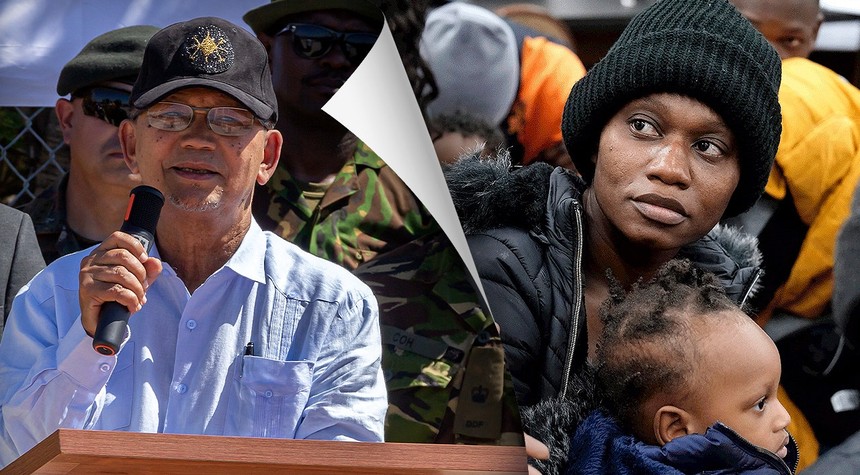
A member of Haiti’s transitional government has acknowledged what many observers have long suspected: the Caribbean nation lacks the capacity to absorb hundreds of thousands of its own citizens should they be returned from the United States.
Leslie Voltaire, one of nine council members leading Haiti’s temporary government ahead of scheduled elections, stated plainly that his country is “helpless” to handle the repatriation of as many as 400,000 Haitians currently living in the United States under Temporary Protected Status. The admission comes as the Trump administration moves to terminate a program that has now extended beyond fifteen years, far exceeding any reasonable definition of “temporary.”
“We think that we are helpless if another country is sending back our compatriots,” Voltaire said. “We cannot do anything about it – just accommodate them, give them money to go back to their provinces and to their cities, help them with food. But it’s very painful due to the small budget that we have in the government.”
The statement reveals a troubling reality: Haiti has become economically dependent on billions of dollars in remittances sent by its citizens working abroad, primarily in the United States, Canada, and France. This dependency raises fundamental questions about sovereignty and the sustainability of current immigration policies.
President Trump attempted to end Haiti’s TPS designation during his first term, but federal courts intervened. The pattern has repeated itself. In November, the Department of Homeland Security published notice that Haiti’s temporary status would not be renewed. However, U.S. District Judge Ana Reyes issued a preliminary injunction this week blocking the administration’s action, arguing the decision was likely motivated by “hostility to non-white immigrants” rather than an objective assessment of conditions in Haiti.
The timing is significant. Three U.S. warships recently arrived off Haiti’s coast as the country approaches its February 7 deadline for the transitional council to transfer power to newly elected leadership. The United Nations, with American support, has also approved deployment of a Gang Suppression Task Force to address ongoing violence plaguing the nation.
When pressed for specific benchmarks that would indicate Haiti had achieved sufficient stability to no longer require TPS, Voltaire offered no concrete metrics. He did not cite targets for police force numbers, territorial control, or economic indicators. Instead, he emphasized that Haiti needs more time, more investment, and greater security.
This vagueness is precisely the problem. Temporary Protected Status was designed as an emergency measure, not a permanent immigration pathway. Yet Haiti has maintained this designation for over fifteen years, with no clear endpoint in sight. The program has effectively become a parallel immigration system, bypassing normal legal channels and creating exactly the kind of dependency Voltaire now describes.
The situation presents a dilemma. No one wishes hardship upon Haiti or its people. Yet the current arrangement serves neither American interests nor Haiti’s long-term stability. A nation that cannot accommodate its own citizens, that relies on remittances from abroad to sustain its economy, faces fundamental governance challenges that temporary protected status cannot resolve.
The presence of American warships and a forthcoming UN task force underscores the severity of Haiti’s instability. Gang violence continues to plague the country, and the transitional government itself acknowledges its limited capacity. These are not conditions that justify maintaining what has become a de facto permanent immigration status for hundreds of thousands of people.
The courts may block the Trump administration’s efforts, as they have before. But judicial intervention cannot change the underlying reality that Voltaire himself has now confirmed: the current system has created unsustainable dependencies on all sides.
Related: Khomeini Grandson Issues Direct Threats Against Israel and United States