
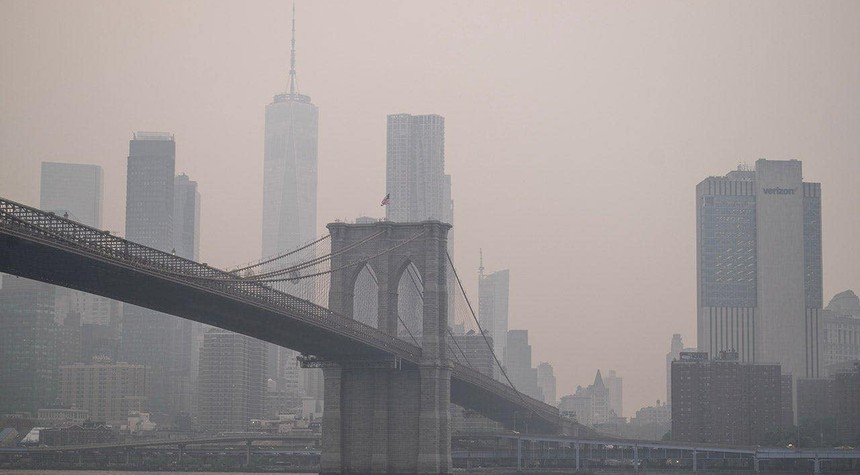
The persistent drift of smoke from Canadian wildfires into American airspace has escalated from an environmental concern to a diplomatic flashpoint, with President Donald Trump on Friday threatening to incorporate the economic costs of air quality degradation into tariffs on Canadian imports.
The President’s statement, delivered via social media, marked an unusually direct confrontation with America’s northern neighbor over forest management practices. Trump announced his intention to contact Canadian Prime Minister Mark Carney directly, characterizing Canada’s approach to forest maintenance as “willful negligence.”
“We are holding Canada responsible for the fact that they are not properly maintaining their forests, and brush therein, and the United States is being unnecessarily invaded by filthy, polluted, and unhealthy air,” the President wrote, employing language that framed the smoke incursion in terms typically reserved for border security discussions.
The timing of this diplomatic pressure coincides with growing concerns from medical professionals about both immediate and long-term health consequences for Americans exposed to wildfire smoke. Medical experts have documented short-term respiratory complications among affected populations, while research continues into potential chronic health impacts from repeated exposure to particulate matter crossing international boundaries.
Forestry specialists have indicated that more aggressive forest management practices could indeed mitigate the severity of certain wildfires. These measures typically include controlled burns, strategic thinning of dense forest stands, and systematic removal of accumulated debris that serves as fuel for larger conflagrations.
The President’s accusation centers on what he termed Canada’s refusal to engage in “basic forest management and debris removal,” suggesting that preventable fires are causing measurable economic harm to American communities through degraded air quality, health care costs, and disrupted commerce.
This approach represents an expansion of the administration’s willingness to employ economic leverage in addressing cross-border issues traditionally handled through environmental cooperation frameworks. The threat to factor smoke damage into trade policy marks a novel intersection of environmental management and economic diplomacy.
Canadian wildfire smoke has affected air quality across significant portions of the United States in recent years, with particularly severe episodes reducing visibility and prompting health advisories in major metropolitan areas. The orange-tinged skies that periodically blanket cities from the Midwest to the Eastern seaboard have become an increasingly familiar sight, raising questions about the adequacy of current bilateral approaches to forest fire prevention.
The economic calculation Trump referenced would presumably attempt to quantify costs including increased healthcare utilization, lost productivity, and potential long-term health expenditures associated with exposure to wildfire particulates. Such an accounting would break new ground in how nations address the cross-border environmental impacts of domestic land management decisions.
As this situation develops, it raises fundamental questions about international responsibility for environmental impacts that cross national boundaries. The President’s framing suggests an administration willing to treat environmental degradation with the same seriousness traditionally reserved for trade imbalances or security concerns.
Whether this approach yields improved forest management practices in Canada or simply adds another layer of complexity to North American trade relations remains to be seen. What appears certain is that wildfire smoke has joined the list of issues where the Trump administration sees room for more assertive American advocacy.
Related: Iranian Strikes Kill US Troops in Jordan Despite Ongoing Peace Negotiations