
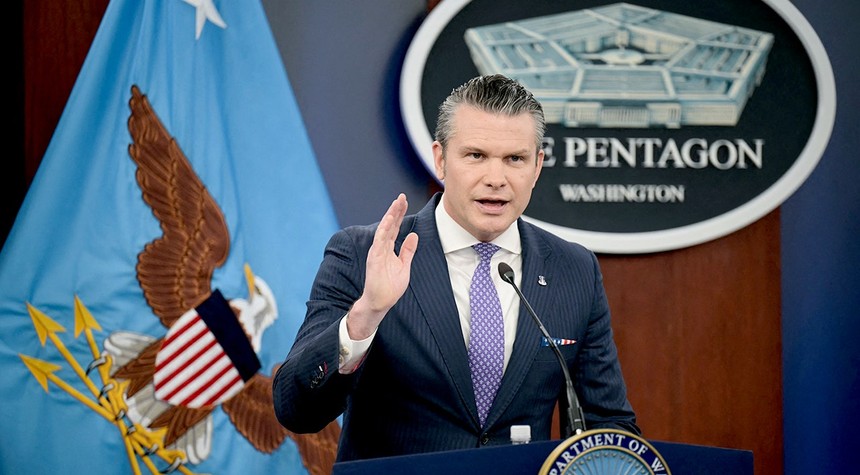
Defense Secretary Pete Hegseth delivered a pointed message to Iranian military commanders Thursday, urging them to accept terms for a peace agreement with the United States while making clear the consequences of refusal.
Speaking from the Pentagon alongside Chairman of the Joint Chiefs of Staff Gen. Dan Caine and U.S. Central Command Commander Adm. Brad Cooper, Hegseth outlined the stark military reality facing Tehran as diplomatic negotiations continue.
“We’re watching you,” Hegseth stated, addressing Iran’s military leadership directly. “Our capabilities are not the same, our military and yours. Remember, this is not a fair fight, and we know what military assets you are moving and where you are moving them to while you are digging out, which is exactly what you’re doing. Digging out of bombed out and devastated facilities.”
The Defense Secretary’s remarks painted a sobering picture of Iran’s current military posture. According to Hegseth, Iranian forces are attempting to recover remaining missile launchers and equipment from damaged installations, but lack the industrial capacity to replace destroyed assets.
“We are only getting stronger. You are digging out your remaining launchers and missiles with no ability to replace them,” Hegseth said. “You have no defense industry, no ability to replenish your offensive or defensive capabilities. You only have what you have.”
The assessment reflects a significant shift in the military balance following recent operations. While Iran can relocate existing equipment, Hegseth emphasized the regime’s inability to reconstitute its forces stands in sharp contrast to American military capabilities.
Should diplomatic efforts fail, Hegseth outlined the consequences awaiting Iranian leadership. “If Iran chooses poorly, they will have a blockade and bombs dropping on infrastructure, power and energy,” he warned. The United States military stands “locked and loaded” to strike Iran’s energy infrastructure if negotiations collapse.
Admiral Cooper, recently returned from forward positions, is currently overseeing what Hegseth described as an “ironclad blockade” while ensuring American forces remain prepared to resume combat operations. President Trump has previously threatened comprehensive action including a blockade of the Strait of Hormuz, through which significant global oil supplies transit.
The Defense Secretary emphasized that American military readiness continues to improve. “We are reloading with more power than ever before and better intelligence, even more importantly, better intelligence than ever before,” Hegseth said.
The Pentagon briefing comes as the United States maintains pressure on Tehran through both diplomatic and military channels. Iran has reportedly threatened to halt Red Sea traffic in response to American naval operations, though such threats appear increasingly hollow given the military imbalance Hegseth described.
The message from the Defense Secretary was unmistakable in its clarity and its intent. The United States possesses overwhelming military superiority, comprehensive intelligence on Iranian military movements, and the will to employ both should diplomacy fail. For Iranian leadership, the choice before them is stark, and the window for wise decision-making may be narrowing.
Related: Australia Commits $53 Billion Defense Increase Despite Falling Short of Trump Target