
Conflicting accounts have emerged from Washington and Tehran regarding a proposed arrangement for Iran to purchase American agricultural products, even as Iranian forces attacked a commercial vessel in the Strait of Hormuz.
President Trump announced Thursday at a White House gathering with American farmers that Iran represents a new market for U.S. agricultural exports. Speaking from the Rose Garden, the president stated that sanctioned Iranian funds would be directed toward purchases of wheat, soybeans, and corn from American producers.
“All over the world, we’re opening up markets for the farmers,” Mr. Trump said. “And we have another one, a new market coming up, and that’s called the lovely country of Iran.”
The president elaborated that the United States would utilize Iranian funds for these agricultural purchases, with the process expected to begin in short order. Earlier this week, he had indicated that any Iranian sanctioned funds released by the Treasury Department would be restricted to purchasing food and medical supplies exclusively from American sources.
However, Iranian Parliament Speaker Mohammad Bagher Ghalibaf, who has participated in negotiations with the United States, flatly contradicted the president’s assertion. In a social media statement Thursday, Ghalibaf dismissed the claim entirely.
“The only crop we’re harvesting is what you planted: decades of mistrust. It’s organic, abundant, and homegrown,” the Iranian official wrote.
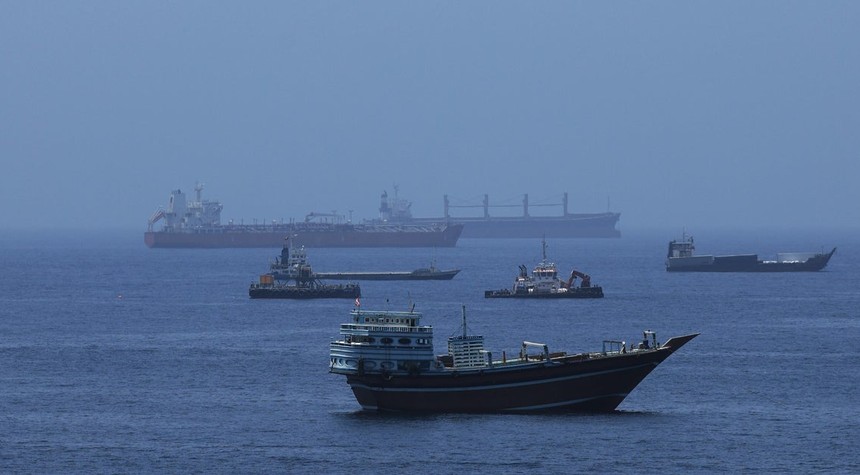
The diplomatic discord comes amid heightened tensions in the Persian Gulf. Iran’s Islamic Revolutionary Guard Corps struck a Singapore-flagged commercial vessel in the Strait of Hormuz on Thursday evening, according to confirmation from U.S. officials. The cargo ship was hit by an unidentified projectile near the Omani coast while transiting the strategic waterway.
The attack appears connected to an ongoing dispute over shipping routes through the strait. The United States has approved a route that follows the Omani coastline, while Iran has insisted vessels use a northern passage under its supervision.
Following the attack, Iran’s Persian Gulf Strait Authority issued a statement asserting that ships traveling outside routes designated by Iranian authorities would forfeit safe passage guarantees and insurance coverage. The agency placed responsibility for any consequences squarely on vessel owners, operators, and commanders who choose alternative routes.
The targeted vessel sustained damage to its bridge but reported no injuries among its crew. The ship continued its voyage following the incident.
The Strait of Hormuz remains one of the world’s most critical maritime chokepoints, with approximately one-fifth of global petroleum passing through its waters. Any disruption to shipping in the region carries significant implications for international energy markets and global commerce.
The apparent contradiction between the administration’s claims of an agricultural agreement and Tehran’s denial raises questions about the current state of negotiations between the two nations. Whether this represents a genuine misunderstanding, a deliberate mischaracterization, or simply the fog of ongoing diplomatic discussions remains unclear.
What is certain is that the combination of disputed trade claims and aggressive Iranian military action in international waters presents a complex picture of U.S.-Iranian relations at this moment.
Related: Denmark Moves Toward National Ban on Islamic Call to Prayer