
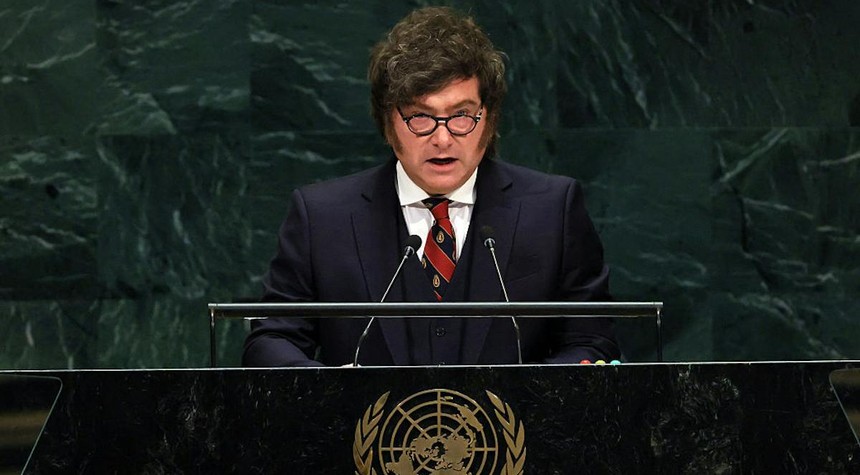
Argentine President Javier Milei delivered one of the most forceful denunciations of the United Nations in recent memory on Wednesday, condemning the international body as a fundamentally failed institution that has betrayed its founding principles.
Speaking before the General Assembly, the libertarian leader spared no criticism in his assessment of what he characterized as an organization that has become disconnected from its stated mission of promoting peace and human rights.
“To tell an uncomfortable truth is always preferable to a comforting lie,” Milei stated at the outset of his remarks. He proceeded to describe the United Nations as having devolved into “a useless organization whose only purpose is to sustain a cast of fatally arrogant parasites masquerading as well-intentioned bureaucrats.”
The Argentine president’s critique focused on what he views as systematic failures across the institution’s core responsibilities. He charged that those entrusted with maintaining collective security and defending human rights have instead presided over the proliferation of chaos, violence, and international terrorism. Milei pointed specifically to the United Nations’ treatment of Israel, noting the body has “systematically voted against Israel while remaining silent in the face of Islamic terrorism and the genocide of Christians in Africa.”
He further accused the organization of providing cover for authoritarian regimes, stating that self-proclaimed defenders of human rights have “sheltered bloodthirsty dictatorships and regimes that stone women in the streets.”
Milei made clear that Argentina under his leadership has chosen an unambiguous strategic direction. “We have unequivocally aligned ourselves with the West, with the United States and with Israel, countries with which we share a deep affinity of values and strategic complementarity,” he declared. This alignment includes condemning Iranian aggression, designating the Iranian Revolutionary Guard as a terrorist organization, and continuing to pursue justice for terrorist attacks on Argentine soil in 1992 and 1994.
The president devoted considerable attention to what he described as the catastrophic handling of the COVID-19 pandemic by international health bodies. Milei characterized pandemic-era restrictions as “a global experiment in social control disguised as science,” arguing that lockdown policies destroyed livelihoods, damaged childhood education, and resulted in countless deaths from isolation and lack of care.
“When a state deprives its population of the right to work, to receive an education, and to bid farewell to their dead, there is a word for it: genocide,” Milei stated. He contended that governments employed “psychological terror” to turn citizens against one another, creating an atmosphere of fear designed to expand state authority long after the public health threat had diminished.
Looking forward, the Argentine leader warned against applying similar regulatory approaches to emerging technologies, particularly artificial intelligence. He noted that throughout history, technological advances from the steam engine to the internet have been met with predictions of catastrophe and mass unemployment, predictions that have consistently proven unfounded.
Milei’s message was unmistakable: Argentina intends to cooperate with the international community, but only on terms that preserve national sovereignty and dignity. “Only a nation that is politically relevant, economically influential and militarily respected can truly be a master of its own destiny,” he concluded.
The speech represents a remarkable moment in international diplomacy, with a head of state using the United Nations platform itself to question the very legitimacy of the institution.
Related: Venezuela Blocks Opposition Leader’s Return as Political Transition Talks Continue