
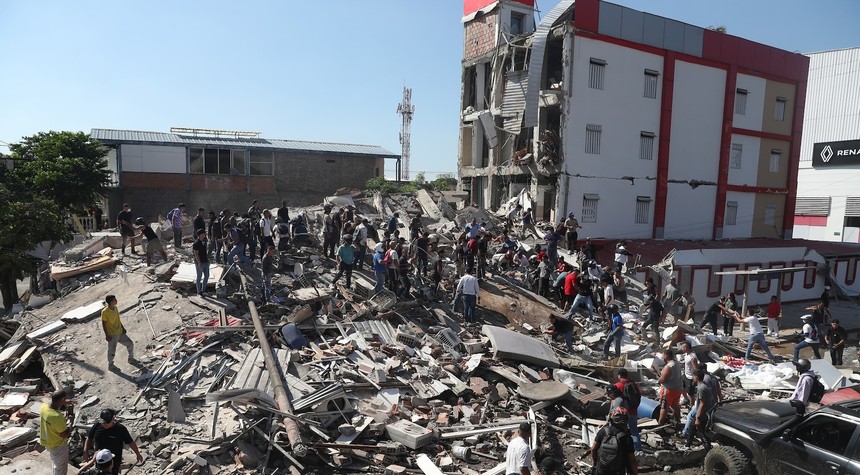
A powerful 7.4-magnitude earthquake struck western Colombia on Monday morning, killing at least 132 people and injuring 572 others in what has become the deadliest seismic event to hit the South American nation in a decade.
President Abelardo de la Espriella has declared a national disaster as rescue operations continue across multiple cities where buildings have collapsed and infrastructure has sustained catastrophic damage. The earthquake’s epicenter was located just five kilometers east of San José del Palmar, according to the United States Geological Survey.
The cities of Pereira and Cali have emerged as the hardest-hit population centers, with dozens of fatalities reported in their respective departments. At least 61 buildings have collapsed throughout the affected region, while more than 1,600 homes have been damaged or destroyed. The destruction extends beyond residential structures, with dozens of health centers, community facilities, and roadways rendered unusable.
In Cali, Colombia’s third-largest city, at least 20 buildings collapsed, trapping residents beneath the rubble. The city’s mayor confirmed that rescue efforts were underway at one location where at least 15 people remained trapped. A hospital in the city suffered severe structural damage, with one wing partially collapsing, forcing the evacuation and relocation of patients to other medical facilities.
The governor of Chocó department reported injuries and severe damage to buildings in the capital city of Quibdó. The widespread impact has forced the suspension of operations at seven airports, including those serving Armenia, Cali, Manizales, Pereira, Quibdó, Buenaventura, and Cartago, further complicating relief efforts.
The capital city of Bogotá, located farther from the epicenter, has thus far been spared major structural collapses, according to officials. However, the tremor was felt throughout Colombia and registered in neighboring Venezuela, Ecuador, and Panama, underscoring the earthquake’s considerable magnitude.
This seismic event represents the strongest earthquake recorded in Colombia in ten years, according to the Colombian Geological Survey. The affected region includes what is known as the Coffee-Growers’ Axis, a vital agricultural area that produces much of the country’s renowned coffee exports.
President de la Espriella announced via video statement that he was traveling to Bogotá to personally coordinate the emergency response. He has established a unified command post to direct relief efforts to the devastated areas and ensure that rescue operations proceed with maximum efficiency.
The United States has signaled its willingness to assist. Secretary of State Marco Rubio issued a statement confirming that the administration is closely monitoring the situation and stands ready to support the Colombian people during this crisis. This response reflects the longstanding partnership between the two nations and America’s commitment to humanitarian assistance in the Western Hemisphere.
As rescue teams work against time to locate survivors trapped in collapsed structures, the full scope of the disaster continues to unfold. The coming days will prove critical as Colombia mobilizes its resources to address immediate humanitarian needs while beginning the long process of recovery and reconstruction.
Related: Daniel Kinahan Returns to Ireland After UAE Refuses to Block Extradition