
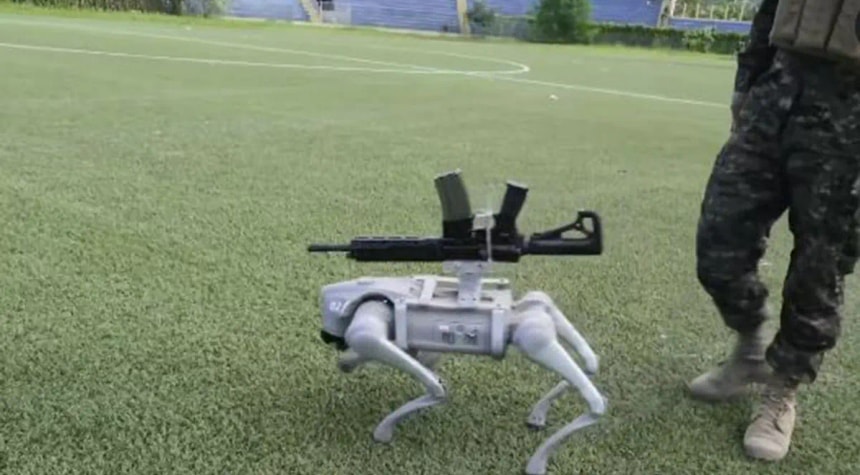
In what marks a significant escalation in the multinational effort to restore order in Haiti, Salvadoran military forces deployed robotic units equipped with firearms during a joint operation this week that successfully reclaimed the Sylvio Cator Stadium in Port-au-Prince from gang control.
President Nayib Bukele of El Salvador announced the operation’s completion, noting that Salvadoran Special Forces worked alongside the Haitian National Police, the Haitian Armed Forces, and a special task force under the terms of a bilateral agreement between the two nations. Video documentation released by the Salvadoran president showed the robotic units, mounted with rifles, advancing through interior corridors and ascending stairways within the facility.
The exact tactical role these robotic systems played in the operation remains undisclosed at this time. However, the technology represents a notable development in the application of unmanned systems to operations against criminal organizations in the Western Hemisphere.
President Bukele reported that several human skulls were discovered inside the stadium during the operation, a grim indication of the violence that has characterized gang control in the region. The Salvadoran leader stated that military forces would establish an operational base at the stadium location to serve as a staging ground for further advances into gang-controlled territory.
According to Bukele’s statements, military forces now maintain tactical advantage on the ground. Prior to commencing offensive operations, the Salvadoran president issued a warning to gang members operating in the area, providing them an opportunity to withdraw from contested zones. He made clear that those who remained to engage with military forces would face the full consequences of that decision.
The operation represents part of a broader effort to combat the extraordinary breakdown of civil order in Haiti, where criminal gangs have exercised effective control over significant portions of the capital and surrounding areas. The security situation has deteriorated to such a degree that international intervention has become necessary to restore basic governmental functions and protect civilian populations.
El Salvador’s involvement in Haiti stems from President Bukele’s success in dramatically reducing gang violence within his own nation through aggressive law enforcement measures and mass incarceration of gang members. His approach, while controversial in some international circles, has achieved measurable results that have attracted the attention of other nations grappling with similar security challenges.
The deployment of armed robotic systems in urban combat operations against criminal organizations marks a technological threshold that may have broader implications for law enforcement and military operations throughout the hemisphere. As gang violence continues to destabilize regions across Latin America and the Caribbean, the methods employed to counter these threats continue to evolve.
The international community will be watching closely to determine whether these joint operations can achieve lasting stability in Haiti, a nation that has endured decades of political instability and violence. The success or failure of this mission may well influence future decisions regarding international intervention in nations where criminal organizations have effectively supplanted governmental authority.
Related: Advocates Fear Loss of Momentum on Religious Freedom Crisis in Nigeria