
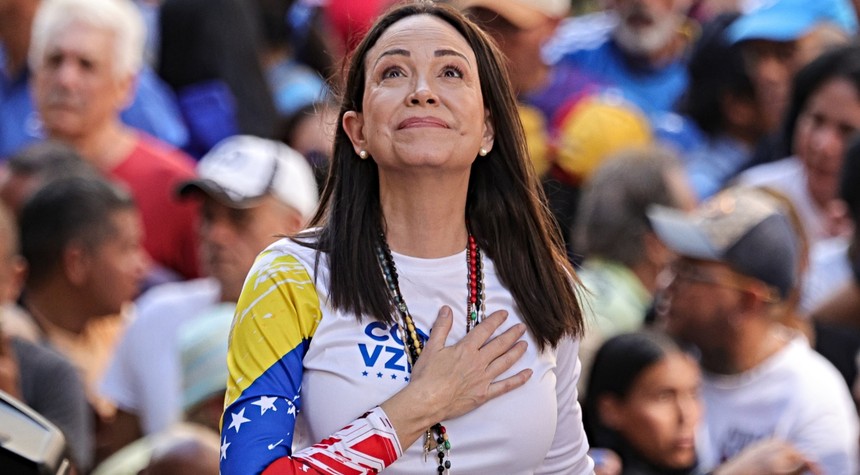
The Norwegian Nobel Institute confirmed Wednesday that Venezuelan opposition leader María Corina Machado will not attend the Nobel Peace Prize ceremony in Oslo, unable to escape the grip of the socialist Maduro regime that has banned her from leaving her homeland.
Kristian Berg Harpviken, director of the Norwegian Nobel Institute, stated that Machado would not be present at Oslo City Hall when the ceremony begins at 1:00 p.m. local time. The absence marks a somber reminder of the authoritarian conditions facing those who dare challenge Venezuela’s ruling regime.
Machado, a former lawmaker and leader of Vente Venezuela, the nation’s only mainstream center-right political party, has been forced into hiding at an undisclosed location within Venezuela. Her concealment follows the fraudulent presidential election of July 2024, after which the Maduro regime leveled charges against her including conspiracy, incitement to hatred, and terrorism. These accusations, dubious in nature and typical of authoritarian governments seeking to silence opposition, carry the threat of immediate arrest.
The travel ban itself dates to 2014, imposed as punishment for Machado’s support of anti-regime protests that year. That restriction remains in force today, a decade-long sentence for the crime of advocating for democratic principles.
In October, the Norwegian Nobel Committee recognized Machado’s courage with the 2025 Nobel Peace Prize, citing her tireless work promoting democratic rights for the Venezuelan people and her struggle to achieve a peaceful transition from dictatorship to democracy. The award represents international acknowledgment of her sacrifice and determination in the face of authoritarian oppression.
Machado’s current whereabouts remain unknown to the public. Her sister, Clara Machado, told Colombian media Tuesday that the family believed she would attempt to reach Oslo, though uncertainty surrounded the possibility. “At this moment, we don’t really know. She is trying to get to Oslo, which is her wish,” Clara Machado said.
Venezuelan Attorney General Tarek William Saab made clear in late November that the regime actively seeks Machado’s arrest. He threatened to declare her a fugitive should she leave Venezuela, stating that being outside the country while facing criminal investigations would constitute fugitive status. The circular logic is characteristic of authoritarian legal systems where the law serves power rather than justice.
Several regional heads of state have traveled to Oslo for the ceremony in a show of solidarity with Machado and the Venezuelan opposition. Argentina’s Javier Milei, Panama’s José Raúl Mulino, Ecuador’s Daniel Noboa, and Paraguay’s Santiago Peña all expressed their intention to stand with her, even in absence. Their presence represents a unified regional rejection of the Maduro regime’s legitimacy.
Jørgen Watne Frydnes, chair of the Norwegian Nobel Committee, acknowledged in November the dangers Machado would face attempting to leave Venezuela, noting the organization’s awareness that such a journey would be perilous.
The situation in Venezuela continues to deteriorate under socialist rule. What was once one of South America’s wealthiest nations, blessed with vast oil reserves, has been reduced to economic ruin and political repression. The Maduro regime’s refusal to allow a Nobel Peace Prize laureate to accept her award on the world stage speaks volumes about the nature of the government and the desperation with which it clings to power.
That María Corina Machado remains committed to her cause despite these circumstances demonstrates the courage that earned her this recognition. Her empty chair in Oslo will serve as a powerful symbol of the ongoing struggle for freedom in Venezuela.
Related: Washington Moves Against Mercenary Pipeline Supplying Forces Accused of Genocide in Sudan