
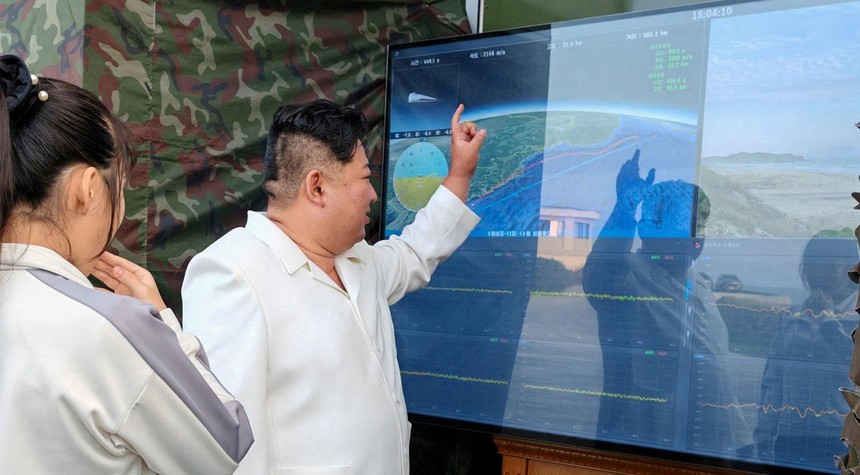
North Korea conducted a test of what state media described as an advanced hypersonic weapon system on Sunday, with leader Kim Jong Un personally observing the launch alongside his teenage daughter, Kim Ju Ae, in what may have been her most significant public appearance to date.
The test represents a continuation of Pyongyang’s determined pursuit of weapons technologies specifically designed to overwhelm modern missile defense systems, and it arrives at a particularly inopportune moment for regional diplomacy.
According to North Korean state media reports, Kim praised the weapon as an “irresistible force” that would prove to be an “incurable headache” for his nation’s adversaries. While official statements did not specify the exact nature of the weapon tested, photographs released by North Korean authorities showed Kim and his daughter examining a display screen labeled “Hwasongpho-11Ma-1 flight trajectory.”
Defense analysts who have examined these images suggest the designation indicates an upgraded variant of an existing short-range ballistic missile system, now fitted with a hypersonic glide vehicle. These weapons represent a significant challenge to existing air defense architectures because they fly at lower altitudes and higher speeds than traditional ballistic missiles, making interception considerably more difficult.
North Korea has been testing various hypersonic weapons platforms since 2021 as part of Kim’s broader effort to modernize his country’s nuclear arsenal. The program reflects Pyongyang’s strategic assessment that advanced delivery systems are essential to maintaining deterrence against what it perceives as existential threats.
The timing of this test could hardly be worse for South Korean President Lee Jae Myung, who is scheduled to address the United Nations General Assembly this week with proposals aimed at reviving dialogue with Pyongyang. Lee has suggested a significant shift in Seoul’s approach, proposing that South Korea drop its longstanding insistence that North Korea commit to complete denuclearization as a precondition for negotiations. Instead, Lee has floated the idea of seeking an initial freeze on further nuclear development.
This represents a marked departure from previous South Korean policy, acknowledging the reality that Pyongyang now possesses a substantial nuclear capability. Estimates of North Korea’s nuclear arsenal vary considerably. South Korean government assessments place the number between 80 and 120 warheads, while President Trump has recently stated the figure is 57.
The Trump administration has also expressed interest in renewed engagement with Kim Jong Un, with the White House indicating that discussions could occur without preconditions, possibly around the Asia-Pacific Economic Cooperation summit in Shenzhen, China, scheduled for November.
President Trump met with Kim three times during his first term, producing considerable diplomatic theater but no concrete progress toward denuclearization. In the years since those summits, North Korea has steadily expanded both its nuclear stockpile and its conventional military capabilities.
Despite recent American gestures, including Trump’s decision last month to scale back the scope of annual military exercises with South Korea, which he characterized as “hostile” to Pyongyang, the Kim regime has shown no indication of interest in resuming negotiations with either Washington or Seoul.
The Korean Peninsula remains technically in a state of war, as the 1953 armistice that ended active hostilities in the Korean War was never replaced with a formal peace treaty. That unresolved status continues to shape the strategic calculations of all parties involved, with North Korea citing the threat of American military action as justification for its nuclear weapons program.
Related: Philippine Ship Struck by Chinese Coast Guard Near Palawan Coast