
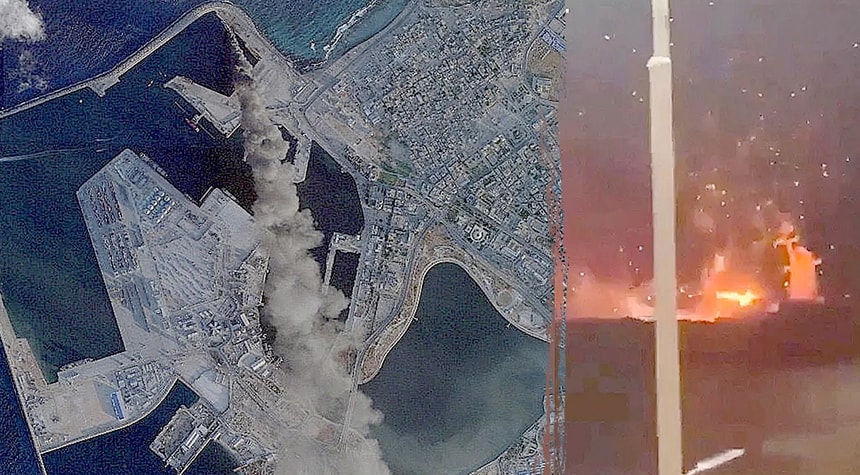
A Russian naval corvette capsized and sank in Benghazi harbor Sunday following what Libyan officials describe as a coordinated sea drone attack, marking a significant expansion of Ukraine’s maritime warfare campaign beyond the Black Sea theater.
The warship Merkury was docked at Benghazi Naval Base for refueling when two explosive-laden sea drones struck the vessel, according to Libyan military officials. Satellite imagery confirmed that most of the warship now rests beneath the surface, with only the bow visible above water. Smoke rose from the ship’s superstructure as debris scattered along the pier. Libyan forces reportedly intercepted and destroyed four additional drones during the attack.
Ten individuals, including both Russian and Libyan nationals, sustained minor injuries and received treatment at local medical facilities. The corvette had been operating under a maritime cooperation agreement with Libya’s eastern-based government when the attack occurred.
Hours after the initial strike, a second drone attack targeted a Maltese-flagged commercial vessel off the Benghazi coast. Libyan naval forces rescued the crew, with health officials reporting minor injuries among crew members who remained in stable condition. By Sunday evening, Libyan naval and air forces had intercepted more than twenty additional drone boats approaching the area.
Libya’s eastern government has responded by requesting an international investigation through both the United Nations General Assembly and Security Council. Prime Minister Osama Hamad specifically called for inquiries into whether the drones originated from western Libya and whether Ukrainian military specialists are operating within Libyan territory.
The eastern government issued a firm statement emphasizing Libya’s neutrality in the Russia-Ukraine conflict. Officials declared that Libya would not permit its ports, territory, or territorial waters to become battlegrounds for foreign disputes. Benghazi remains under the control of forces loyal to General Khalifa Haftar, whose self-styled Libyan National Army dominates eastern and southern Libya while maintaining close ties with Russia.
Libya’s current division stems from the 2011 uprising that toppled Moammar Gadhafi. A United Nations recognized government operates from Tripoli in the west, while a rival administration controls much of the east and south. This political fracture has created a complex environment where international conflicts can find secondary theaters.
The Benghazi attack represents the latest evolution in Ukraine’s expanding naval drone campaign. In December, Ukrainian forces reportedly struck a Russian-linked oil tanker with aerial drones in the Mediterranean Sea. Three months later, Russia accused Ukraine of attacking a liquefied natural gas tanker with naval drones launched from the Libyan coast.
Libyan officials have previously confirmed to international press that Ukrainian drone specialists have been operating from military facilities in western Libya, including an air base in Misrata and installations in Tripoli and Zawiya. These revelations suggest a developed infrastructure supporting Ukrainian operations in North Africa.
The incident underscores the increasingly global nature of the Russia-Ukraine conflict, as both nations seek to strike military and economic targets far beyond the immediate war zone. Ukraine’s demonstrated ability to project force into the Mediterranean poses new challenges for Russian naval operations and complicates Moscow’s relationships with regional partners.
For Libya, the attacks present a diplomatic crisis that threatens to drag the already divided nation further into international conflicts while undermining its stated neutrality. The coming weeks will reveal whether international investigations can determine responsibility and prevent Libya from becoming a persistent proxy battlefield in a war being fought thousands of miles to the north.
Related: Republican Lawmaker Targets National Security Vulnerability in Shared Digital Infrastructure