
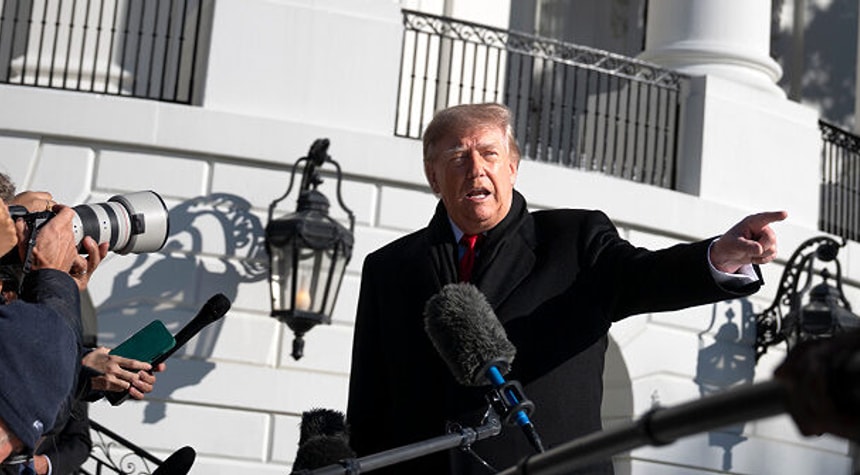
President Donald Trump delivered a stark warning to Tehran on Sunday, stating that any Iranian vessels attempting to challenge the American naval blockade would be sent to the bottom of the sea. The president’s remarks came as intelligence reports indicate Iran has assembled more than fourteen oil tankers near its primary export terminal, with threats of retaliatory strikes against Gulf energy infrastructure should American forces move to intercept them.
The confrontation represents the most significant test yet of the renewed blockade, now in its one hundred and thirtieth day, which has brought Iranian crude oil exports to what Treasury Secretary Scott Bessent described as a critical standstill. The economic pressure has deprived Tehran of vital revenue streams and pushed the regime toward a decision point between negotiation and confrontation.
When asked about reports of Iran’s preparations to test the blockade, Trump told reporters he hoped they would attempt it, adding that Iranian vessels would meet the same fate as the rest of their navy. The president also indicated his inclination to order renewed military strikes against Iran after the New Year should negotiations fail to produce results, suggesting he expects further exchanges of force between American and Iranian military assets.
Trump characterized Iranian negotiators as professional tap dancers, accusing them of prolonging discussions without making meaningful concessions. The president noted that Iran has grown more aggressive in recent weeks, launching more drones and missiles in the past seven days than at any point during the previous year, though all attacks were intercepted without causing damage.
The escalation follows increasingly direct threats from Tehran’s leadership. Mohsen Rezaei, a former Revolutionary Guard commander who currently heads Iran’s Supreme National Security Council, indicated last week that he had received instructions to bring the country’s prolonged state of neither peace nor war to a swift conclusion.
Iranian Foreign Minister Abbas Araghchi declared that Tehran intends to break the American blockade, while Deputy Foreign Minister Kazem Gharibabadi characterized the restrictions as an act of war on Saturday, vowing that Iran would take whatever measures necessary to end them. Nevertheless, Gharibabadi maintained that Tehran remains willing to pursue negotiations through mediators, including Qatar, underscoring the regime’s dual approach of diplomatic engagement and military threats.
The tankers assembled near Kharg Island, Iran’s principal crude export terminal, are reportedly prepared for a potential voyage through the Strait of Hormuz toward China. Iranian media have promoted a proposed blockade-breaking operation dubbed Operation Fereydoun, under which the tankers would sail openly under Iranian flags, potentially announcing their destination in advance.
Tehran has threatened to strike energy facilities in Saudi Arabia, the United Arab Emirates, and Qatar if American forces attempt to stop the vessels, raising concerns that a confrontation at sea could spread across the Persian Gulf. Iranian television discussions have even explored placing journalists, civilians, and international antiwar activists aboard the tankers, potentially complicating American interception efforts.
Despite these preparations and increasingly explicit threats, there remains no confirmation that Iran’s leadership has ordered the convoy to sail or that an organized attempt to break the blockade has begun.
The United States has tightened enforcement of the blockade in response. New guidance issued Wednesday expanded restrictions to cover vessels receiving Iranian cargo through transfers at sea. Under the updated rules, American forces may stop, board, divert, or seize vessels receiving cargo from ships subject to the blockade, even if the receiving vessels never entered Iranian waters. Ships refusing lawful orders could face enforcement measures, including the use of force.
The blockade has become central to the Trump administration’s broader economic campaign against Tehran. Treasury Secretary Bessent pointed to the disruption of Iranian oil exports as evidence that global markets can function without the regime’s crude, declaring that the regime has exhausted its seaborne oil supply and may never see revenue from oil it has already sold.
The restrictions have compounded an economic crisis inside Iran, where rolling electricity cuts, fuel shortages, and disrupted industrial production have intensified public frustration with the regime. Iranian President Masoud Pezeshkian acknowledged Saturday that the country faces a silent economic war more difficult than military strikes.
Speaking to a capital markets conference in Tehran, Pezeshkian described the situation as an economic war that presents challenges far exceeding those of conventional military conflict. As Tehran weighs its next move, the question remains whether the regime will attempt to break the blockade through force or seek an accommodation through diplomatic channels before the president’s indicated deadline for renewed military action after the New Year.
Related: Russian Warship Sinks in Libyan Port After Suspected Ukrainian Drone Attack