
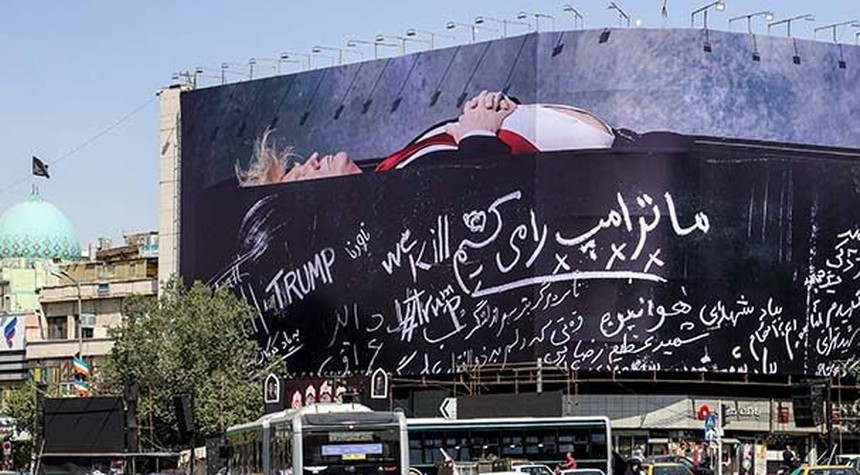
The Iranian regime on Wednesday unveiled a massive billboard in central Tehran depicting President Donald Trump lying dead in a coffin, marking an extraordinary escalation in public threats against an American head of state.
The billboard, which curves around the side of a building overlooking Islamic Revolution Square, shows the President’s image in a state suggesting death, with rigid positioning and bloated features intended to represent rigor mortis. The display occupies one of the busiest intersections in the Iranian capital, a location the regime frequently uses for state-sponsored rallies and demonstrations.
Written largely in Farsi but including the English phrase “We Kill Trump,” the billboard features graffiti-style messages that appear designed to evoke the memorial displays created during last week’s funeral for Ayatollah Ali Khamenei. One message references “Minab’s children,” an apparent allusion to the Iranian city where a United States airstrike on February 28 reportedly struck an elementary school.
The display represents the latest manifestation of threats that have permeated Tehran since Khamenei’s death. The week-long funeral proceedings included both official state pronouncements and orchestrated crowd demonstrations calling for the American president’s assassination. Participants hanged Trump in effigy, carried banners demanding his death alongside that of Israeli Prime Minister Benjamin Netanyahu, and chanted slogans rejecting diplomatic solutions in favor of violence.
During a government-approved speech at the funeral, Iranian poet Mohammad Rasouli articulated the sentiment in stark terms, questioning why the President remains alive and suggesting his death would be necessary to avenge Khamenei.
The brazen nature of these threats raises serious questions about international norms and diplomatic protocols. Publicly displayed death threats against a sitting American president constitute an unprecedented breach of diplomatic conduct, even accounting for the long-standing hostility between Washington and Tehran since the 1979 Islamic Revolution.
The timing of this display coincides with heightened tensions following recent military actions in the region. The reference to Minab suggests the Iranian regime is leveraging civilian casualties to justify and legitimize threats against American leadership, a propaganda technique with deep historical roots in the region.
The location of the billboard in Enqelab Square carries particular significance. The square has served as a staging ground for major regime demonstrations throughout the Islamic Republic’s history. A statue of Khamenei now stands in the same square, creating a symbolic geography where veneration of Iranian leadership exists alongside calls for violence against American authority.
These developments present serious implications for regional stability and American security interests abroad. The public nature of the threats, combined with their official sanction through placement in a regime-controlled public space, suggests coordination at the highest levels of Iranian government.
The international community now faces questions about appropriate responses to such unprecedented provocations. The display stands as a test of diplomatic resolve and raises fundamental questions about the boundaries of acceptable state behavior in an increasingly volatile Middle East.
And that is the way it is.
Related: G4S Guards Linked to Fatal Incidents at Kenyan Agricultural Site