
The United States Treasury Department has imposed additional sanctions on financial networks supporting Hezbollah, the Iranian-backed militant organization operating in Lebanon. The action represents the latest effort in what officials have designated Operation Economic Outcast.
Among the entities targeted is the Wa Ta’awanu Association, which American officials describe as a charitable organization serving as cover for Hezbollah activities while ostensibly providing humanitarian services. Treasury Secretary Scott Bessent stated that the Iranian regime’s efforts to undermine Lebanese sovereignty through terrorist proxies will not be tolerated, and that the United States government remains committed to disrupting Iran’s regional influence operations.
The sanctions package also addresses an alleged gold and cash smuggling operation run jointly by Hezbollah and the Quds Force, which operates under Iran’s Islamic Revolutionary Guard Corps. These financial networks have long enabled the organization to maintain operations despite international pressure.
The situation in southern Lebanon remains volatile. Hezbollah and Israel have engaged in sporadic conflict for years, but current hostilities escalated following American and Israeli strikes on Iranian targets in February. Hezbollah responded with missile and drone attacks against northern Israel, prompting an Israeli military incursion into southern Lebanon.
Military coordination between the United States and Israel continues at the highest levels. Israel’s military chief, Lieutenant General Eyal Zamir, met with United States Central Command leader Admiral Brad Cooper in Tel Aviv this week. The two commanders discussed regional developments and shared security challenges. Israeli officials characterized the meeting as addressing the importance of deepening strategic and operational cooperation between the two militaries.
A subsequent trilateral meeting included Zamir, Cooper, and Roman Gofman, director of Mossad, Israel’s foreign intelligence service. Central Command, which oversees American military operations throughout the Middle East, has assumed an increasingly prominent role in the current administration’s defense strategy.
The United States and Israel have been considering whether to resume larger-scale military operations against Iran. Previous discussions prior to the November election failed to produce agreement. On Tuesday, American forces conducted a strike on Qeshm Island, which officials characterized as defensive action following unsuccessful Iranian attacks against Bahrain.
The regional conflict has expanded beyond the immediate theater. A powerful explosion shook the Saudi capital of Riyadh on Wednesday, as Yemen’s Iranian-backed Houthi rebels continued their campaign of attacks against Saudi Arabia. The Saudi-led coalition fighting the Houthis reported intercepting two cruise missiles and two drones launched toward Riyadh and southern regions.
Riyadh residents reported that the explosion occurred without the customary cellphone warnings typically issued during aerial threats. One resident in northern Riyadh described the blast as extremely loud, noting that hearing such an explosion without advance warning proved frightening. The precise location remained unclear, though witnesses reported seeing smoke near the city’s airport.
Director of National Intelligence Jay Clayton testified before the House Homeland Security Committee that Iranian threats both inside and outside the United States have dramatically increased. Clayton emphasized the government’s commitment to detecting, deterring, and combating Iranian lethal plotting. He described online radicalization as a genuine concern, noting how foreign extremist networks can influence individuals already residing within American borders.
Deputy FBI Director Christopher Raia acknowledged that while intelligence regarding possible plots does not always indicate attackers possess the capability to execute their plans, authorities take all such information seriously.
Saudi Arabia now anticipates its conflict with the Houthis will extend into 2027, according to Western officials briefed on the kingdom’s planning. The Yemen civil war had largely quieted following a 2022 ceasefire, but fighting resumed over the summer as regional tensions intensified. Thousands have died and hundreds of thousands have been displaced. Houthi rockets have killed at least twenty people inside Saudi Arabia.
Saudi authorities have confirmed Houthi targeting of critical infrastructure, including airports and oil facilities. The kingdom expects the current campaign to continue for at least six more months, hoping to achieve military gains before re-entering negotiations. This week, however, Yemeni government forces withdrew from strategic Red Sea coastal territory as Houthi forces advanced.
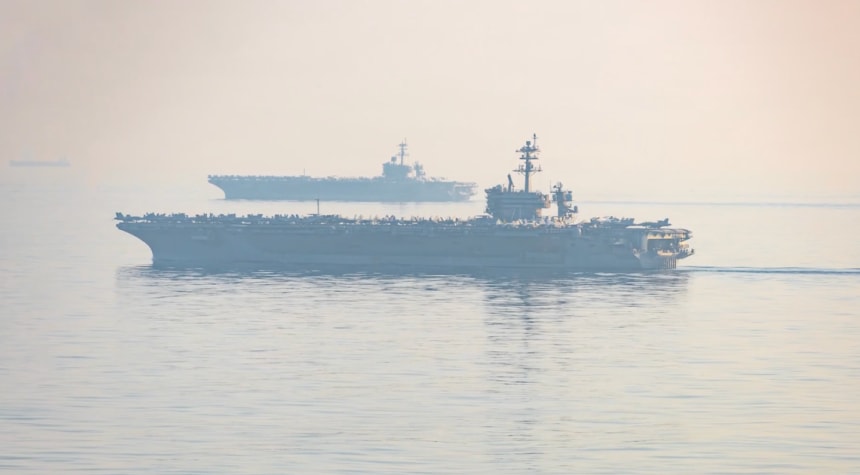
The United States military’s Central Command this week released images of the USS Theodore Roosevelt and USS George Washington aircraft carriers operating together in the Arabian Sea, a demonstration of American naval presence in the region.
And that is the situation as it stands this evening in the Middle East, where sanctions, military coordination, and ongoing hostilities continue to shape a complex and dangerous landscape.
Related: European Leaders Reject American Suggestion to Renegotiate NATO Security Architecture