
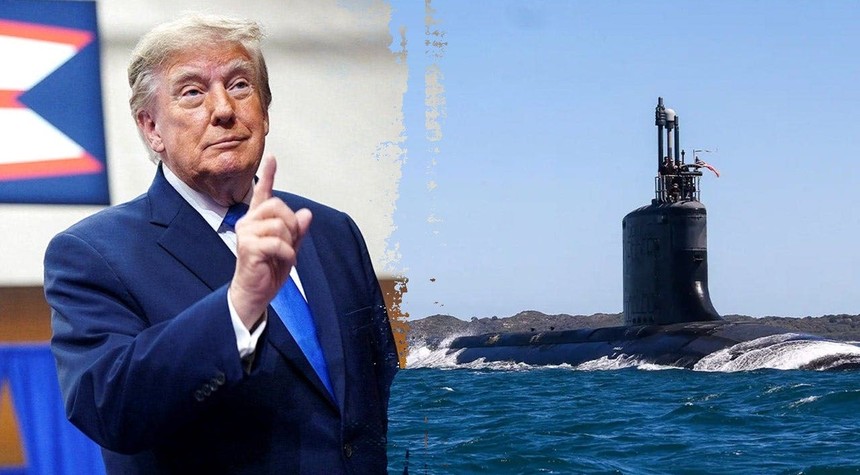
The United States faces a sobering reality in its competition with China for maritime supremacy. While the People’s Republic continues its unprecedented naval expansion, America’s shipbuilding capacity has faltered, delivering barely half the submarine production rate the Navy requires to maintain strategic parity.
In response to this challenge, the Trump administration announced a $6.6 billion initiative to accelerate production of Virginia-class attack submarines, enlisting defense technology firm Anduril to construct a massive manufacturing facility at the historic Sparrows Point shipyard outside Baltimore. President Donald Trump visited the site Tuesday afternoon to formally unveil the partnership.
The arrangement represents an unconventional approach to a problem that has bedeviled military planners for years. Rather than relying solely on traditional defense contractors, the administration has turned to a Silicon Valley-style manufacturer known for innovation and speed. Anduril will invest $3.7 billion of its own capital to build a 2-million-square-foot facility capable of producing critical submarine components and eventually large sections of the vessels themselves. The Navy, in turn, will pay up to $2.9 billion for the actual production output.
This structure places substantial financial risk on the contractor while tying government expenditure directly to results rather than development processes. It marks a departure from conventional Pentagon procurement practices that have often resulted in cost overruns and delayed delivery schedules.
The urgency driving this initiative cannot be overstated. The Navy currently produces approximately 1.3 Virginia-class submarines annually, falling well short of its stated requirement of two per year. Current projections suggest the service will not reach that production rate until 2032. Meanwhile, China’s shipbuilding capacity dwarfs America’s, allowing Beijing to expand its naval forces at an alarming pace.
The new facility aims to add roughly 9 million labor hours annually to the submarine industrial base, representing approximately a 15 percent increase in production capacity. This expansion comes as the Navy operates 26 Virginia-class submarines, with two additional vessels expected to enter service this spring.
Vice President JD Vance has championed efforts to strengthen American shipbuilding more broadly, viewing maritime industrial capacity as essential to national security. The administration’s focus extends beyond submarines to encompass the entire spectrum of naval construction and maintenance capabilities that have atrophied in recent decades.
The deepening relationship between Anduril and the Pentagon signals a willingness to embrace non-traditional defense contractors who promise to bring commercial sector efficiency to military production. This philosophy represents a calculated gamble that innovation and private capital can solve problems that have resisted conventional solutions.
Whether this approach succeeds remains to be seen. The submarine industrial base has proven resistant to previous reform efforts, hampered by workforce shortages, supply chain bottlenecks, and the inherent complexity of nuclear vessel construction. Yet the alternative is continued decline in a domain where American naval superiority has historically guaranteed global stability and freedom of navigation.
The stakes extend far beyond industrial policy. Control of the seas has determined the course of great power competition throughout history. As China continues its naval buildup with apparent determination to dominate the Western Pacific and beyond, America’s response will shape the strategic balance for generations to come.
That is the way it is.
Related: Norwegian Government Proposes Ban on Smart Glasses Technology in Tourist Areas