
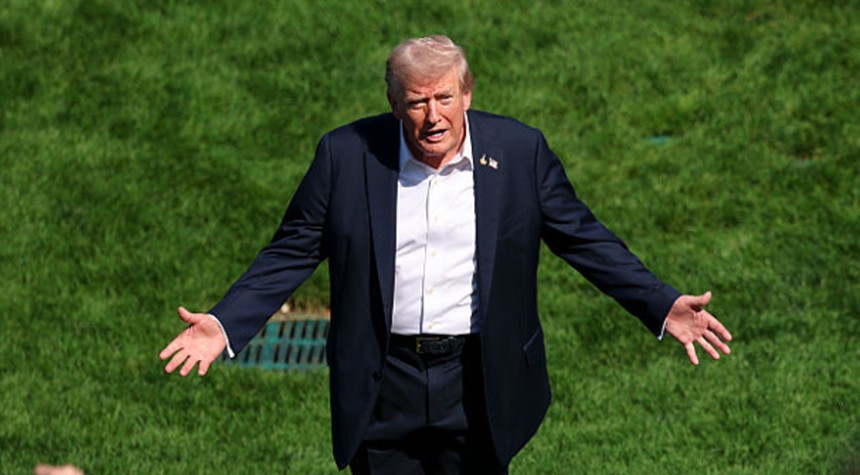
President Donald Trump indicated Thursday evening that the United States may substantially reduce or entirely eliminate the federal income tax within the coming years, citing projections of substantial revenue from his administration’s expanded tariff program.
Speaking at a Thursday event, the President outlined an ambitious fiscal restructuring that would fundamentally alter how the federal government finances its operations. “In the next couple of years, I think we’ll substantially be cutting, or maybe cutting out completely, but we’ll be cutting income tax,” Trump stated. “Could be almost completely cutting it because the money we’re taking in is going to be so large.”
The proposal rests on Congressional Budget Office projections released in June, which estimated that the administration’s tariff increases will reduce the federal deficit by $2.8 trillion over the next decade. These figures represent a significant revision to previous deficit forecasts and provide the fiscal foundation for the President’s tax elimination proposal.
The tariff measures under consideration span a comprehensive range of imported goods. The analysis covers policies implemented between January and May of this year, including a thirty percent levy on imports from China and Hong Kong, twenty-five percent duties on automobiles, automotive parts, steel, and aluminum, and a ten percent general tariff on most other imports. Additionally, the administration has eliminated duty-free treatment for low-value Chinese shipments.
Before accounting for economic effects, the Congressional Budget Office estimates the new tariffs will reduce primary deficits by $2.5 trillion, with an additional $500 billion reduction in interest payments, totaling $3.0 trillion in deficit reduction. After considering modest economic impacts, including slightly lower gross domestic product growth and temporarily elevated inflation, the net deficit reduction stands at $2.8 trillion.
The administration has also proposed a novel approach to public communication regarding tariff policy. Commerce Secretary Howard Lutnick discussed in November the concept of a tariff dividend check, designed to help Americans directly understand the fiscal impact of the trade measures.
“The President wants to make sure the American people understand that the tariffs are there for their benefit,” Lutnick explained. “Yes, it’s going to drive down our deficit. Yes, it’s going to make the country stronger. But he wants the people of America, the American people to appreciate these tariffs, and he knows if he puts money into their pocket and says, ‘Look, this was paid for by the tariffs,’ they’ll better understand how important this is for America.”
This approach represents a return to nineteenth-century fiscal policy, when tariffs rather than income taxes provided the primary source of federal revenue. The income tax, established permanently by constitutional amendment in 1913, has served as the cornerstone of federal financing for more than a century.
The feasibility of such a dramatic restructuring depends on sustained tariff revenue and the willingness of trading partners to maintain current import levels despite higher costs. Economic analysts will be watching closely to determine whether the projected revenue materializes as anticipated.
Related: Haitian Migrants Face February Deadline as Federal Protection Status Terminates