
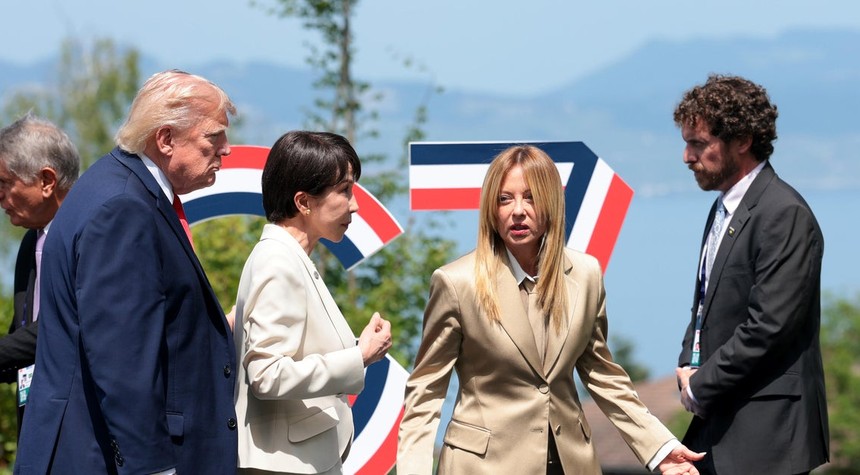
A diplomatic rift has opened between Washington and Rome following remarks attributed to President Trump regarding his interaction with Italian Prime Minister Giorgia Meloni at this week’s G7 summit in France.
According to Italian television channel La 7, Mr. Trump told the network that Prime Minister Meloni “wanted a picture with me so badly” and that he only agreed because he “felt sorry for her.” The network released only an Italian-dubbed version of the conversation, leaving the precise wording unverified. “She begged me to take a picture with her,” the president reportedly said. “I wouldn’t have taken it, but I felt sorry for her.”
The response from Rome was swift and unequivocal. Prime Minister Meloni, addressing the remarks in a video statement, called the president’s characterization “made up” and declared that “neither I nor Italy ever beg.” Her tone reflected genuine bewilderment at the treatment from an administration she had cultivated as a partner.
“I don’t know why the president of the United States behaves this way with his own allies,” Meloni said. She added pointedly that it was “a pity he doesn’t show the same determination with enemies of the West, with enemies of the United States, with leaders with whom, instead, he is far more accommodating.”
The Italian government took concrete action in response. Foreign Minister Antonio Tajani canceled a planned visit to the United States scheduled for June 21 and 22, calling the president’s words “serious and offensive” and stating they “offend all of Italy.”
This public discord marks a significant deterioration in what had appeared to be one of the Trump administration’s strongest European partnerships. Meloni was the only European leader to attend the president’s second inauguration in January. Her right-wing political orientation and previous expressions of alignment with Mr. Trump’s worldview positioned her as a natural ally among major European leaders, many of whom have been openly critical of American policy under this administration.
Just days ago, following the G7 summit, Meloni characterized the gathering as having “a very positive climate” with “no friction” between Mr. Trump and other leaders. Video from the event showed the two leaders engaged in what appeared to be substantive conversation.
The relationship has faced mounting pressure over the ongoing Iran conflict. In April, after Mr. Trump criticized Pope Leo XIV’s anti-war stance, Meloni called his remarks “unacceptable.” The president responded sharply, telling an Italian newspaper he was “shocked at her” and had been “wrong” about her courage.
More recently, Mr. Trump has threatened to withdraw American forces from Italy, arguing the country “has not been of any help to us” in the Iran war. This criticism mirrors similar complaints the administration has directed at NATO allies generally, questioning their contributions to collective defense and American military operations.
The current situation presents a diplomatic puzzle. Italy remains a crucial NATO member and hosts significant American military installations. Prime Minister Meloni represents the kind of conservative European leadership the administration might reasonably expect to find common ground with on matters of policy and principle.
Whether this breach can be repaired, or whether it represents a fundamental miscalculation in the administration’s approach to alliance management, remains to be seen. What is clear is that the foundation of trust necessary for effective partnership has been damaged, and rebuilding it will require more than photographs at summits.
Related: Trump Offers Conditional Support for Netanyahu Ahead of Israeli Elections