
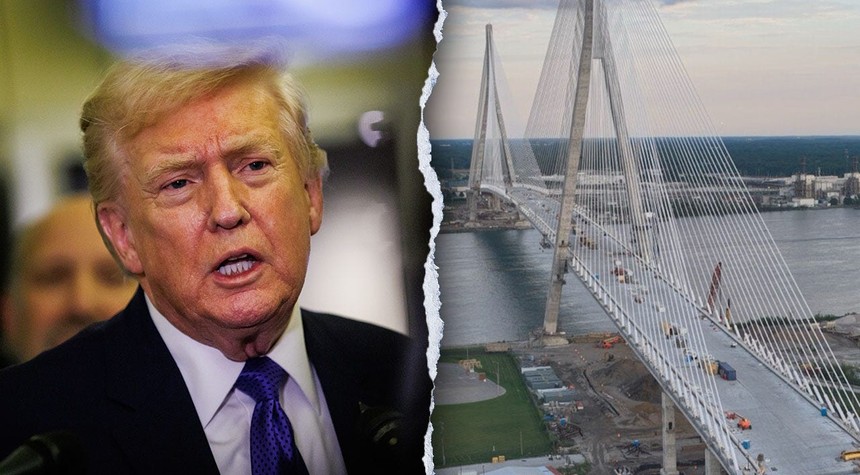
President Donald Trump announced Monday that he will prevent the opening of a major international bridge connecting Michigan and Canada unless Ottawa addresses what the administration characterizes as longstanding trade imbalances and unfair commercial practices.
The Gordie Howe International Bridge, named for the legendary hockey player who spent much of his career with the Detroit Red Wings, remains under construction between Detroit and Windsor, Ontario. The project represents a significant infrastructure investment intended to facilitate cross-border commerce and travel between the two nations.
In his statement, the President outlined specific grievances regarding the bridge’s construction and broader trade relations. Chief among these concerns is the alleged exclusion of American materials and products from the bridge project itself, despite what the administration describes as substantial U.S. contributions to Canadian infrastructure and defense.
The President stated that negotiations must commence immediately, asserting that the United States deserves compensation for its investments in Canadian projects and security. He suggested that American ownership of a significant portion of the bridge asset would be appropriate given the circumstances.
The administration points to a waiver granted during the Obama presidency that allowed Canada to circumvent the Buy American Act. This legislation requires federal agencies to purchase materials manufactured domestically with predominantly American-made components. The President characterized this waiver as a strategic error that has enabled Canada to proceed with major infrastructure projects without incorporating American steel and other materials.
Additional friction has emerged over Ontario’s liquor distribution policies. The President noted that American spirits, beverages, and other alcoholic products face prohibition from Canadian store shelves in that province, representing what the administration views as discriminatory trade practices.
The statement also addressed broader geopolitical concerns, specifically Canada’s economic relationship with China. The President warned that Canadian Prime Minister Mark Carney’s apparent interest in strengthening commercial ties with Beijing could prove detrimental to Canadian interests, suggesting that such arrangements would leave the United States with unfavorable secondary effects.
This development marks the latest chapter in ongoing trade tensions between Washington and Ottawa. The President has consistently maintained that existing trade arrangements have disadvantaged American workers and industries, a position that formed a cornerstone of his campaign platform.
The Gordie Howe International Bridge project has proceeded for several years as a joint infrastructure initiative. Its completion would provide an additional crossing point for the substantial commercial traffic that moves between the American Midwest and central Canada daily. The Detroit-Windsor corridor represents one of the busiest commercial border crossings in North America.
The administration’s position reflects a broader reassessment of international trade relationships and infrastructure partnerships. Whether this stance will bring Canada to the negotiating table on terms favorable to Washington remains to be seen. What is certain is that this dispute affects not merely symbolic matters, but the practical movement of goods and people across a border that has historically represented one of the world’s most peaceful and productive international boundaries.
The coming days will reveal whether diplomatic channels can resolve these tensions or whether this infrastructure project will become another casualty of deteriorating trade relations between longtime allies.
Related: Australian Liberal Party Faces Leadership Crisis After Coalition Reunification Deal