
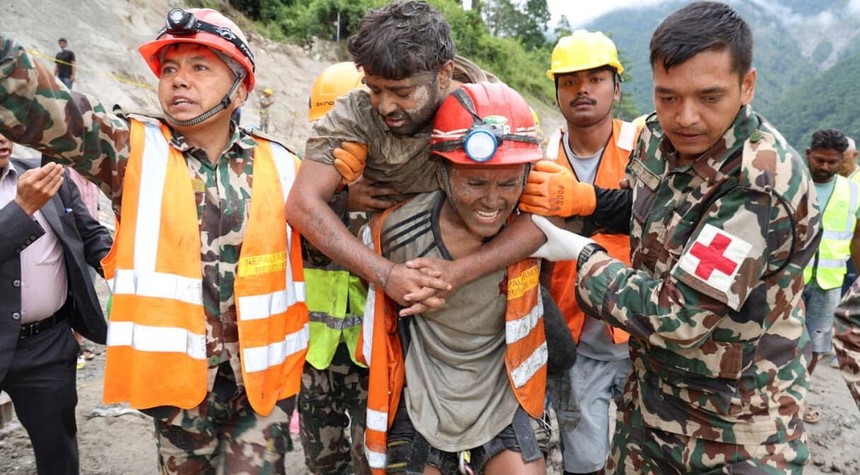
Nine days after catastrophic floods devastated Nepal’s mountainous regions, rescue teams successfully extracted two workers alive from the Trishuli 3A hydropower tunnel on Friday, offering a measure of hope amid what has become one of the nation’s deadliest natural disasters in recent memory.
The rescue of mechanical foreman Sanjay Shah and mechanical supervisor Kabir Maharjan came after emergency teams detected voices from deep within the tunnel system Friday morning. Both men were found in stable condition, covered in mud but alive, and were immediately airlifted to medical facilities in Kathmandu for treatment.
The floods, believed to have been triggered by a glacier collapse on August 26, have claimed at least 1,287 lives across Nepal and left more than 5,000 people missing. The disaster swept away entire villages and transformed the landscape of communities along the Trishuli River valley.
At the hydropower project site, approximately 557 workers remain unaccounted for, with rescue officials estimating that 115 individuals may be trapped within the main tunnel complex. The tunnel system itself presents unique challenges for rescue operations. Rather than a simple passage, it consists of multiple chambers and corridors that extend in various directions beneath the mountain.
The trapped workers, many of them among Nepal’s most skilled engineers, may have been working to secure their own survival throughout their ordeal. Energy advisers familiar with the site have suggested these individuals likely possess the technical knowledge to locate oxygen sources and navigate the complex tunnel system, though time remains their greatest adversary.
Nepal’s Foreign Minister Shisir Khanal expressed cautious optimism following Friday’s successful extractions, noting that additional voices have been detected deeper within the tunnels. The discovery has reinvigorated rescue efforts, though officials acknowledge uncertainty about the precise number of survivors who may still be reached.
Television footage broadcast across Nepal showed the first rescued worker being carried from the tunnel entrance on a rescuer’s shoulder, a moment that brought tears of relief to families who have maintained vigil at the site for more than a week. Medical personnel have advised the survivors to limit speaking due to their weakened condition.
The human cost of this disaster has extended beyond Nepal’s borders. Chinese authorities reported that 21 of their citizens were killed in related flooding, with 541 still missing as of late Wednesday.
For the families of those still trapped, Friday’s rescues have transformed nine days of anguish into renewed determination. Amir Maharjan, brother of rescued supervisor Kabir Maharjan, struggled to articulate the family’s emotions. His sister-in-law, Hirashova Maharjan, described ten days during which the family could neither eat nor drink properly, consumed by fear and uncertainty.
As rescue operations continue around the clock, the successful extraction of these two men demonstrates both the resilience of those trapped below and the dedication of emergency teams working under extraordinarily difficult conditions. The clock continues to tick for those still waiting in darkness, but Friday’s developments have proven that survival remains possible even after more than a week beneath the earth.
The Independent Power Producers Association of Nepal continues to coordinate with government disaster management agencies as the search proceeds, mindful that each passing hour diminishes the chances for those still trapped while refusing to abandon hope that more voices will yet be answered.
Related: Federal Court Strips Naturalized Citizenship From Indian Immigrant After Rape Conviction