
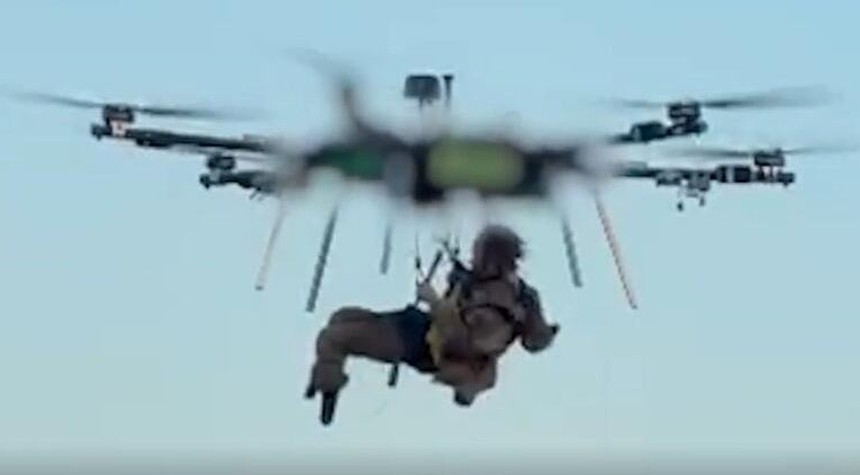
In what represents a significant milestone in modern battlefield innovation, Ukrainian military forces have successfully completed the world’s first front-line medical evacuation using an aerial drone, as the Russian invasion approaches its fifth year.
The Ukrainian Ground Forces’ 92nd Assault Brigade confirmed Monday that it evacuated a wounded soldier from an impossibly isolated position using a modified heavy-lift drone, marking another chapter in Ukraine’s increasingly sophisticated deployment of unmanned systems in combat operations.
The rescued soldier, Konstantyn Vlasenko of the 30th Separate Brigade, had been stranded in his position for nearly 500 days. Dense Russian mining operations and sustained enemy drone activity had rendered the area unreachable by conventional ground forces or robotic vehicles. The situation deteriorated when a Russian drone wounded Vlasenko earlier this year while he remained trapped, forcing him to perform partial self-amputations of both legs while awaiting rescue.
The operation employed a Ukrainian-manufactured Gurzuf Defence heavy hexacopter, originally designed as an attack platform for dropping ordnance on Russian positions. The company provided the aircraft to the military without charge and worked closely with military specialists to modify the unmanned system. The modifications ensured stable transport of a human passenger without dangerous flipping or swinging motions. Testing preceded the actual rescue mission.
Four separate Ukrainian brigades coordinated the complex operation, which required seven days of preparation. The execution phase lasted approximately one hour and fifteen minutes, during which the drone traveled nearly forty miles. Ukrainian forces deployed additional drones as decoys to divert Russian attention from the rescue flight.
Pavlo Feldbloom, co-founder of Gurzuf Defence, emphasized that his company did not originally intend to create an evacuation-specific platform. Rather, they developed a heavy-duty, modular, multi-mission system capable of various payloads. While the company recognized that such load-bearing capacity naturally enabled rescue operations, Feldbloom cautioned against viewing aerial evacuation as a standard practice.
The risks to wounded personnel during aerial transport remain extraordinarily high, according to Feldbloom. He characterized such evacuations as last-resort measures, appropriate only when no alternative method exists to preserve life.
Ukrainian forces had previously attempted to reach Vlasenko using ground-based drone technology, another innovation developed during this conflict. That unmanned ground vehicle was destroyed en route, according to the Ukrainian Armed Forces 2nd Mechanized Battalion.
Upon landing in Ukrainian-controlled territory, Vlasenko described his evacuation flight as calm and expressed profound relief at returning to friendly ground.
This operation demonstrates Ukraine’s continued adaptation to the realities of modern warfare, where unmanned systems increasingly perform roles traditionally requiring human presence. The successful rescue also highlights the brutal nature of this conflict, where front-line positions can become isolated islands surrounded by lethal obstacles, leaving wounded soldiers stranded for months while medical help remains tantalizingly close yet unreachable.
As this war continues into its fifth year, both sides have transformed the battlefield into a testing ground for emerging technologies, with drones assuming ever-expanding roles in reconnaissance, attack, logistics, and now emergency medical evacuation.
Related: Supreme Court Asked to Review Detention of Pro-Palestinian Activist