
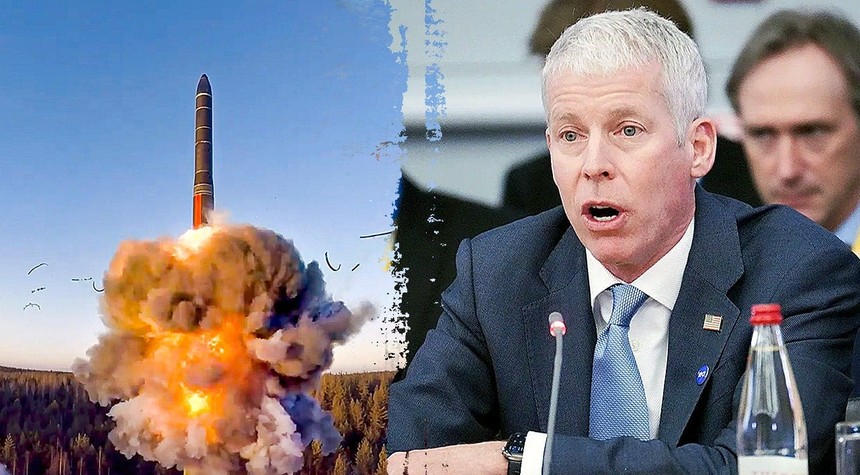
The United States has returned to Cold War era levels of nuclear weapons production, a development that marks a significant shift in American defense posture after decades of reduced manufacturing capacity.
Energy Secretary Chris Wright informed the Senate Armed Services Committee on Thursday that the National Nuclear Security Administration is now delivering more new nuclear weapons and plutonium pits than at any time since the conclusion of the Cold War. Wright characterized this expansion as part of a broader American “nuclear renaissance.”
This acceleration in weapons production comes as a direct response to what defense officials describe as an unprecedented expansion of China’s nuclear capabilities. The buildup represents a fundamental change in the strategic calculus that has governed great power relations since the fall of the Soviet Union.
Senate Armed Services Committee Chairman Roger Wicker of Mississippi warned that Beijing has moved beyond its historical posture of minimum nuclear deterrence. Under President Xi Jinping’s leadership, China is constructing a substantially larger and more sophisticated nuclear arsenal, fundamentally altering the global balance of power that has existed for the past three decades.
The concerns extend beyond China alone. Officials at Thursday’s hearing also pointed to growing nuclear threats from Iran, adding another dimension to an increasingly complex international security environment.
In a separate development that underscores the intricate nature of American-Chinese relations, President Donald Trump announced that President Xi has committed to purchasing 200 Boeing aircraft. This substantial order would provide a significant boost to American manufacturing and represents a bright spot in otherwise tense bilateral relations.
The juxtaposition of these two developments illustrates the complex reality of modern great power competition. Even as the United States prepares for potential military confrontation through expanded nuclear production, economic ties between the world’s two largest economies remain substantial and mutually beneficial.
The ramping up of nuclear weapons production represents more than merely a technical achievement. It signals a recognition within the American defense establishment that the post-Cold War era of assumed American nuclear superiority has ended. China’s rapid military modernization, combined with its expanding nuclear arsenal, has forced Washington to reconsider assumptions that have guided defense policy for a generation.
The plutonium pit production that Secretary Wright referenced is particularly significant. These components are essential to modern nuclear weapons, and their manufacture requires sophisticated facilities and expertise that had atrophied during the decades when such production was deemed unnecessary.
The question facing American policymakers is whether this nuclear expansion will serve as an effective deterrent or whether it risks accelerating an arms race that could destabilize the international order. Historical precedent from the Cold War offers both cautionary tales and potential roadmaps for managing such competition without catastrophic consequences.
What remains clear is that the international security environment has entered a new phase, one that bears uncomfortable similarities to the tensions of the mid-twentieth century, but with the added complexity of economic interdependence and multiple nuclear powers. How America navigates this challenge will define global security for decades to come.
Related: Xi Jinping Warns Trump That Taiwan Issue Could Lead to Conflict Between Major Powers