
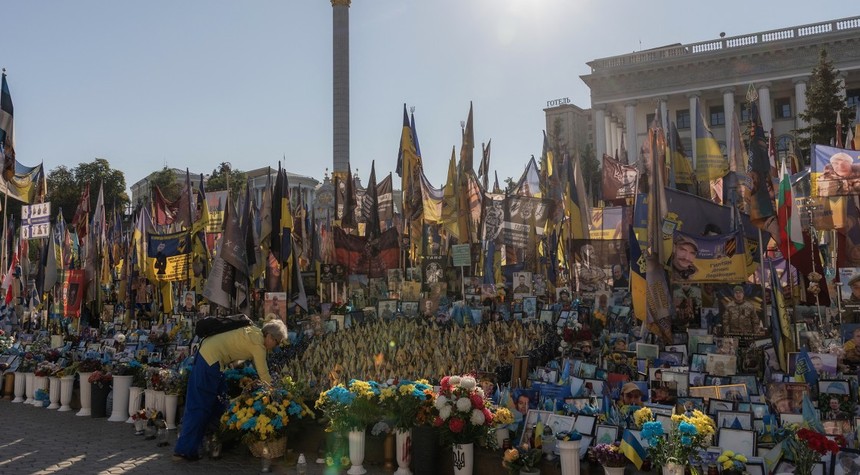
Western leaders gathered in Kyiv on Monday to commemorate 35 years since Ukraine declared independence from the Soviet Union, but the absence of senior American officials marked a conspicuous shift in Washington’s engagement with the embattled nation.
Britain’s Andy Burnham flew directly to the Ukrainian capital to co-chair a meeting of the Coalition of the Willing, a group of nations supporting Ukraine’s defense. France’s Emmanuel Macron and Germany’s Friedrich Merz participated by call. European Council President António Costa joined nearly a dozen European heads of state in Kyiv, even as Russian rocket and drone strikes continued overnight.
The United States, once Ukraine’s most vital supporter, sent no senior administration officials to the public ceremonies. This absence carries particular weight as Monday also marks four and a half years since President Vladimir Putin launched his full-scale invasion of Ukraine’s much smaller neighbor.
Secretary of State Marco Rubio issued a statement congratulating Ukraine and affirming that “the United States is committed to Ukraine’s sovereignty and continues to work to support a negotiated settlement to the Russia-Ukraine war that establishes a lasting and durable peace.” Ukrainian Foreign Minister Andrii Sybiha responded graciously, thanking Rubio for his greetings and adding, “We will be glad to welcome you in Kyiv.”
Several senators and former officials did visit Ukraine around the anniversary. Senators Richard Blumenthal and James Lankford met with Ukrainian President Volodymyr Zelenskyy over the weekend, with Blumenthal attending Monday’s ceremony. Former Vice President Mike Pence and former special envoy Keith Kellogg also traveled to Kyiv for meetings.
The facts are these: American support for Ukraine has undergone substantial changes since President Trump returned to office in early 2025. According to analysis by the Council on Foreign Relations, Congress has made available $195 billion in spending related to the Ukraine war through March of this year. However, significant new direct aid has ceased flowing from Washington. Instead, the administration has shifted to selling weapons to Ukraine’s NATO partners, who then transfer them to Kyiv.
This represents a fundamental restructuring of American support at what many analysts consider a critical juncture. President Trump once promised to achieve peace within 24 hours. Those negotiations have stalled. Meanwhile, supplies of American air defense missiles continue to dwindle, and Putin has escalated threats against Ukraine’s allies.
The contrast could hardly be starker. European leaders stood in Kyiv despite ongoing Russian attacks, demonstrating solidarity in person rather than through diplomatic statements. The question facing observers is whether this shift represents a tactical recalibration or a strategic retreat from America’s commitment to Ukrainian sovereignty.
Neither the State Department nor the White House responded to requests for comment explaining why no senior officials attended the anniversary events. That silence, perhaps, speaks as loudly as any statement could.
The United States provided not only billions in military aid but also critical intelligence sharing that proved vital to Ukraine’s defense. Whether that partnership continues with the same intensity remains an open question as European allies step forward to fill what appears to be a growing gap in American engagement.
Related: Navy Sailor’s Father Detained by ICE During Middle East Deployment