
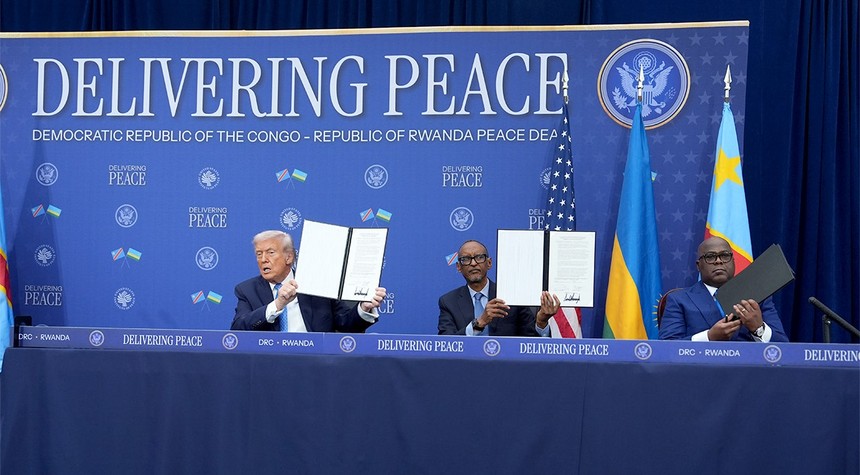
President Donald Trump presided over the signing of a comprehensive peace agreement between Rwanda and the Democratic Republic of Congo on Thursday, marking what may prove to be a significant diplomatic achievement with substantial economic implications for American interests.
The ceremony at the United States Institute of Peace formalized the Washington Accords, a peace framework that addresses a conflict spanning three decades between the two African nations. The agreement includes provisions for a permanent ceasefire, the disarmament of non-state armed groups, the return of displaced refugees, and accountability measures for those responsible for atrocities committed during the prolonged conflict.
Beyond the humanitarian dimensions of the accord, the President announced bilateral agreements that grant the United States access to critical rare earth minerals from both nations. This development carries considerable strategic weight, given America’s current dependence on foreign sources for materials essential to modern technology, defense systems, and renewable energy infrastructure.
“Today, the United States is also signing our own bilateral agreements with the Congo and Rwanda that will unlock new opportunities for the United States to access critical minerals and provide economic benefits for everybody,” Trump stated during the ceremony.
The mineral provisions represent more than mere commercial opportunity. They constitute a measured response to a strategic vulnerability that has concerned defense and economic planners for years. Rare earth elements are indispensable for manufacturing everything from smartphones to guided missiles, and securing reliable sources outside the sphere of geopolitical competitors serves clear national interests.
Rwandan President Paul Kagame acknowledged the unprecedented nature of the diplomatic breakthrough, noting that numerous previous attempts to resolve the underlying tensions had failed. “We have seen countless negotiations and efforts, but none has succeeded in resolving the underlying issues. President Trump introduced a new and effective dynamism that created the space for breakthroughs,” Kagame observed.
Democratic Republic of Congo President Felix Tshisekedi joined Kagame in expressing gratitude for the American administration’s role in facilitating the agreement. Both leaders participated in the signing ceremony beneath a backdrop reading “Delivering Peace,” a phrase that will either be vindicated or contradicted by the implementation of the accord in the months ahead.
The Washington Accords formalize terms initially agreed upon by both nations in June, suggesting that Thursday’s ceremony represented the culmination of sustained diplomatic engagement rather than a sudden development. The agreement’s success will ultimately be measured not by the signatures on the document, but by whether the ceasefire holds, whether refugees can safely return to their homes, and whether justice is genuinely pursued for victims of the conflict.
For the United States, the dual achievement of facilitating peace while securing access to strategic resources represents the kind of diplomacy that serves both humanitarian principles and national interests. Whether this framework proves durable remains to be seen, but the agreement represents a serious attempt to address a conflict that has destabilized central Africa for a generation while simultaneously addressing America’s strategic mineral requirements.
That is the way it is.
Related: Alliance Defending Freedom Enters Australian Education Controversy Over Classroom Material