
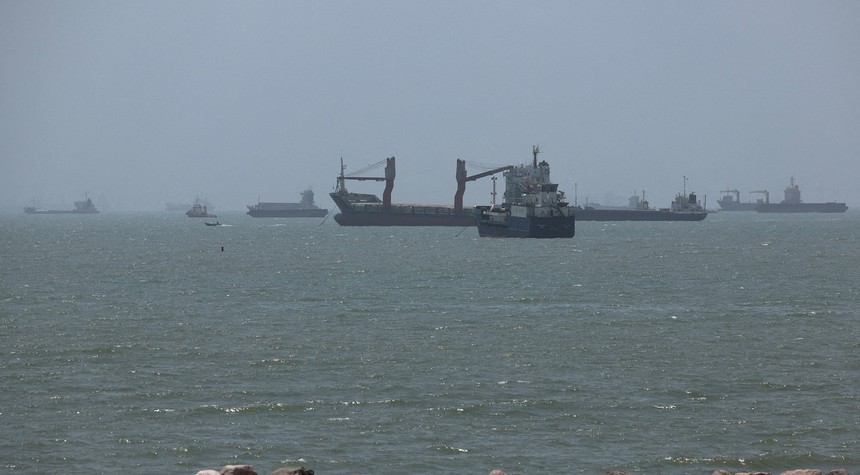
United States military forces struck two Iranian rocket launch sites on Larak Island Sunday evening, escalating tensions in the strategically vital Strait of Hormuz even as negotiations between Washington and Tehran continue in their third month.
According to a United States official, Iranian Revolutionary Guard Corps forces were observed preparing rockets armed with sea mines for deployment into the Strait of Hormuz, prompting the American strike. Larak Island sits in the Persian Gulf at the eastern terminus of the strait, through which nearly one-fifth of the world’s petroleum passes.
The Iranian Revolutionary Guard Corps responded swiftly, stating through Iran’s official news agency that the American military action “will be responded to” and “will lead to punishment of the aggressor.”
That promised retaliation may have come Monday morning, when Jordanian air defense systems intercepted and destroyed eight missiles in the kingdom’s airspace. The Jordanian Armed Forces successfully neutralized the missiles before they threatened citizens or property, according to the country’s state media. While the origin of the missiles has not been officially confirmed, the timing suggests Iranian involvement.
This exchange of fire occurs against the backdrop of ongoing negotiations that began in June, following President Donald Trump’s announcement of “major combat operations” against Iran in late February. Those operations included massive joint United States and Israeli strikes targeting Iranian military, government, and infrastructure sites across the country.
The negotiations aim to produce a comprehensive war-ending agreement based on a memorandum of understanding signed by both nations. Yet the diplomatic efforts have not prevented continued military actions, with the Strait of Hormuz remaining the primary point of conflict.
Admiral Brad Cooper, commander of United States Central Command, released a video statement Thursday evening confirming that American forces had successfully cleared Iranian mines from the strait’s international shipping lanes. Cooper stated that the mines had been laid months earlier, though neither he nor President Trump specified the extent of Iran’s mining operations.
The mine clearing operation involved Navy divers, Navy SEALs, and air power working in coordination. Cooper reported that United States forces have overseen the safe passage of 1,500 commercial vessels carrying a combined 750 million barrels of crude oil through the waterway. More than twenty American warships and hundreds of aircraft, operated by thousands of service members, have maintained this effort.
“We have turned around 75 vessels attempting to run the blockade and disabled three vessels which did not comply when directed,” Cooper said in his video update.
The Trump administration’s approach represents an attempt to increase economic pressure on Tehran while simultaneously pursuing diplomatic resolution. The strategic importance of the Strait of Hormuz to global commerce makes any disruption to shipping through the waterway a matter of international concern. Roughly twenty percent of the world’s oil supply passes through this narrow channel between Iran and the Arabian Peninsula.
The current situation demonstrates the complex reality of modern conflict, where military operations and diplomatic negotiations proceed simultaneously. Whether this dual-track approach will lead to a sustainable resolution remains uncertain. What is certain is that the free flow of commerce through the Strait of Hormuz remains essential to the global economy, and the United States military remains committed to ensuring that flow continues unimpeded.
Related: Search Continues for 2,000 Missing After Nepal-Tibet Flash Flood Disaster