
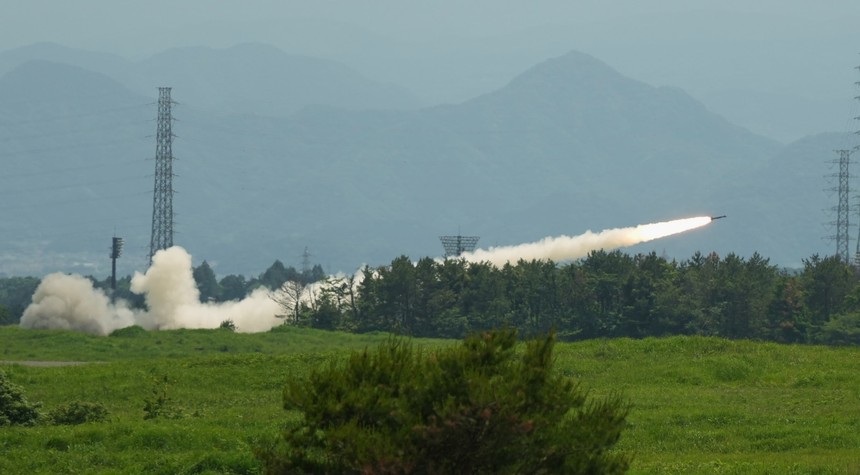
American Marines conducted a live-fire exercise Wednesday at Camp Fuji, launching a dozen rockets from a High Mobility Artillery Rocket System in a demonstration that underscores the evolving nature of modern warfare and America’s commitment to Pacific security.
The exercise, conducted in the foothills of Japan’s Mount Fuji approximately two hours from Tokyo, represents only the second time this particular weapon system has been tested at the installation. The demonstration was carried out in close coordination with Japanese military forces, with local roads temporarily closed as a safety precaution.
The HIMARS platform represents a fundamental shift in artillery doctrine. Mounted on the chassis of a military truck, the system can be rapidly deployed from concealed positions, fire its payload, and relocate before enemy forces can respond with counter-battery fire. Military strategists refer to this as “shoot and scoot” tactics, a methodology that has become increasingly vital as unmanned aerial systems proliferate across modern battlefields, rendering static artillery positions dangerously vulnerable to detection and destruction.
This weapon system has proven its worth in combat operations. American forces employed HIMARS in both Iraq and Afghanistan. More recently, Central Command confirmed its use in the opening strike against Iran, where it launched a new precision-guided rocket capable of striking targets hundreds of miles distant.
That extended range carries particular significance in the Pacific theater. As tensions persist over Taiwan, which Beijing claims as sovereign Chinese territory and has explicitly refused to rule out seizing by military force, the United States continues seeking credible deterrent capabilities. HIMARS batteries equipped with the latest long-range missiles, if positioned on Japanese islands or other nearby territories, could readily engage targets throughout the Taiwan Strait.
The strategic calculus is straightforward. China’s growing military assertiveness in the region demands that America and its allies maintain the capability to respond swiftly and effectively to any aggression. The mobility and firepower of systems like HIMARS provide commanders with flexible options that static defenses simply cannot match.
Wednesday’s exercise employed only training projectiles rather than live warheads, and the rockets fired were of the shorter-range variety typically associated with the platform. Nevertheless, the demonstration served its purpose: maintaining proficiency among Marine artillery crews and signaling American readiness to potential adversaries.
The close coordination with Japanese forces during the exercise reflects the deepening security partnership between the two nations. Japan has grown increasingly concerned about Chinese military activities in the region, particularly regarding Taiwan, and has taken steps to modernize its own defense capabilities.
As military technology advances and potential adversaries develop more sophisticated surveillance and targeting systems, the American military continues adapting its tactics and equipment. The HIMARS system exemplifies this adaptation, trading the massive firepower of traditional artillery for mobility, survivability, and precision.
That is the way it is in the Pacific today: American forces training alongside allies, preparing for contingencies all parties hope will never materialize, yet understanding that readiness itself serves as the most effective deterrent to conflict.
Related: French Football Match Abandoned After Mob Storms Field in Nantes Stadium