
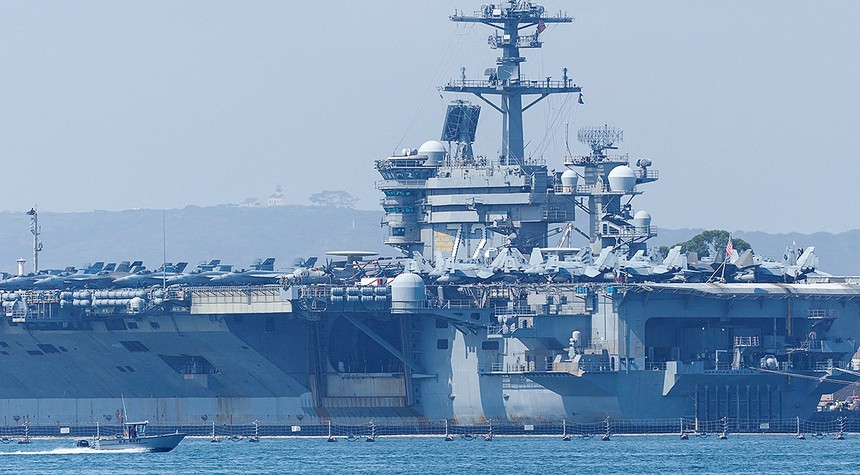
The USS Abraham Lincoln is steaming toward its home port in San Diego after months of successful combat operations in the Middle East, but the carrier’s return comes at a moment of troubling uncertainty for America’s naval future.
Lincoln’s crew of 5,000 sailors has earned their homecoming. During their deployment, they destroyed more than 200 Iranian drones threatening commercial shipping lanes in the Red Sea and Persian Gulf. The carrier itself became a target when Iranian forces attempted to strike the vessel, but as Captain Daniel J. Keeler noted in July, those attacks never came close to succeeding. In one notable engagement, an F-35C stealth fighter launched from Lincoln’s deck shot down an Iranian drone that had ventured too near the carrier in February.
While Lincoln heads home, the USS George H.W. Bush and USS George Washington remain on station in the North Arabian Gulf, maintaining what military planners call a steel wall naval blockade and conducting strikes against Iranian-backed Houthi forces. Those Houthis launched fresh drone and missile attacks into Saudi Arabia recently, injuring thirteen civilians and demonstrating the continued volatility of the region’s security situation.
The strategic importance of these deployments cannot be overstated. Global oil trade routes depend on the security umbrella provided by American carrier strike groups, and Iran’s persistent attempts to disrupt commercial shipping represent a direct challenge to international commerce and freedom of navigation.
Yet even as these carriers perform their missions with distinction, a directive from Washington threatens to undermine the very technological advances that will prove essential in any future confrontation with China’s rapidly expanding navy.
On August 13th, the White House issued a National Security Presidential Memorandum ordering the Navy to present options for returning to steam catapults on aircraft carriers, abandoning the electromagnetic launch systems that have been years in development. This represents a fundamental misunderstanding of where naval aviation must go to maintain American maritime superiority.
The electromagnetic aircraft launch system, which uses magnetic force rather than steam to propel aircraft down the flight deck, has proven itself in combat conditions. The USS Gerald R. Ford completed more than 12,200 launches during its most recent deployment, which lasted 326 days. The combat data validates the system’s reliability and effectiveness.
More importantly, the electromagnetic catapults recharge faster than steam systems, allowing carriers to launch aircraft at higher rates during sustained combat operations. This capability will prove crucial in any high-intensity conflict with a peer competitor like China.
The future of carrier aviation depends on continued modernization. The MQ-25 Stingray refueling and reconnaissance drone, with its 75-foot wingspan, will extend the operational reach of carrier air wings by delivering fuel from stations 1,000 miles distant from the carrier itself. Smaller collaborative combat aircraft drones carrying additional weapons and electronic warfare systems will follow, multiplying the striking power of each carrier.
These unmanned systems require the precise launch capabilities that electromagnetic catapults provide. The adjustable nature of the magnetic system allows it to launch aircraft of varying weights, from lightweight drones to heavy strike fighters, with greater efficiency than steam catapults ever could.
The Pentagon faces a choice between proven innovation and comfortable familiarity. The electromagnetic launch system represents years of investment, testing, and now combat validation. Reversing course would squander that investment precisely when America needs every technological advantage against a Chinese navy that is growing in both size and capability.
The sailors of the Abraham Lincoln have done their part. They have proven American naval power works when properly equipped and deployed. The question now is whether Washington will provide the next generation of carriers with the tools they need to maintain that superiority in the more dangerous waters ahead.
Related: Canada Seeks Economic Security Through Expanded Partnership with European Union