
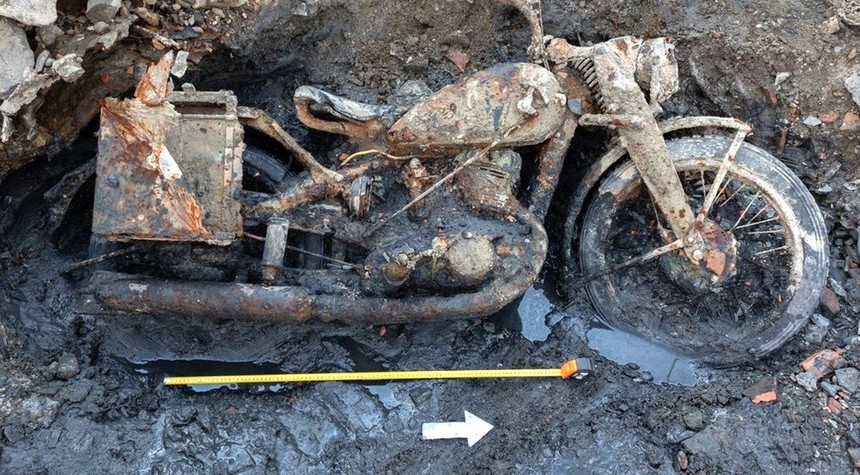
The muddy bottom of the Danube River in central Budapest has surrendered a piece of history this summer that speaks to the chaos and tragedy of World War II’s final months in Europe. A Wehrmacht motorcycle, identified by officials as a DKW NZ 350-1 model, has been recovered from the river more than eight decades after Nazi Germany’s defeat, bringing with it the remains of two German soldiers whose names remain unknown.
The German War Graves Commission, an organization dedicated to locating, recovering, and identifying German war dead, announced the discovery in August. What emerged from the harbor mud was a heavily corroded but remarkably intact motorcycle, its frame, wheels, fuel tank, and storage boxes preserved by the unique chemical composition of the riverbed.
According to the commission, the harbor mud’s mixture with gas oil created conditions that prevented complete deterioration of the metal and other materials. The DKW NZ 350-1 was considered particularly robust and reliable during the war years, a workhorse vehicle for German military operations across the European theater.
The discovery carries added significance because of what accompanied the motorcycle. Two well-preserved identification tags were recovered alongside the remains of the soldiers. These metal tags, which Wehrmacht personnel wore around their necks, were designed with a specific purpose in mind. When a soldier fell in battle, one half of the tag would remain with the body while the other half was sent to the Wehrmacht Information Office to notify the soldier’s family of his death.
The presence of both intact tags with these remains suggests something went terribly wrong in the final accounting of these men. Diane Tempel-Bornett, a spokesperson for the German War Graves Commission, explained that the tags are still being deciphered, but their discovery does not guarantee they belonged to the recovered soldiers.
“The fact that the identification tags were found with the dead does not necessarily mean that they belonged to them, although that is quite possible,” Tempel-Bornett stated. The intact nature of both tags, however, strongly indicates these soldiers were never properly recovered or officially accounted for in the war’s aftermath.
The challenge of identification remains considerable. Tempel-Bornett noted that determining the soldiers’ identities can be a lengthy and complex process, particularly given the passage of time and the condition of the materials involved.
This discovery forms part of a larger pattern across Europe, where changing environmental conditions have revealed artifacts and remains from both World Wars. The Danube, which flows through ten countries and served as a major strategic waterway during World War II, has proven particularly rich in such discoveries as water levels fluctuate and harbor areas undergo development or examination.
For the families of missing German soldiers, approximately 1.3 million of whom remain unaccounted for from World War II, such discoveries offer the possibility of closure, however delayed. The German War Graves Commission continues its work across Europe and beyond, seeking to provide dignity to the fallen and answers to their descendants.
The motorcycle and remains now rest in the care of the commission as the painstaking work of identification continues.
Related: Australian Children’s Author Terry Denton Dies at 76