
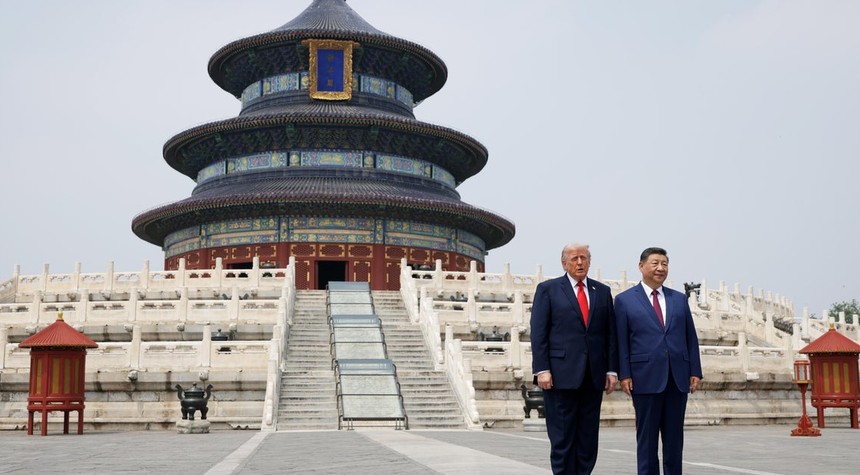
Treasury Secretary Scott Bessent stated from Beijing on Thursday that China has a substantial interest in reopening the Strait of Hormuz and will likely work behind the scenes to influence Iranian leadership on the matter.
Speaking during his visit to China alongside President Trump, Bessent told reporters that Chinese officials will do what they can to address the situation, given their critical dependence on Middle Eastern oil shipments through the strategic waterway.
“It is very much in China’s interest to get the Strait of Hormuz reopened, and I think they will be working behind the scenes, to the extent anyone has any say over the Iranian leadership,” Bessent said.
The Treasury Secretary acknowledged the complexity of the current situation in Tehran, where recent military actions have created a leadership vacuum. “The real problem here is we did not change the regime, but the regime changed,” he explained. “Several layers of leadership were decapitated and it is very tough there just to communicate anything to anyone who is able to either act or get an overall agreement and speak on behalf of the Iranian leadership.”
Iran has begun allowing select Chinese vessels to pass through the strait following discussions between Tehran and Chinese diplomatic officials. Iranian semi-official media reported Thursday that Tehran granted passage to Chinese ships after talks with China’s foreign minister and ambassador, though it remains unclear whether these vessels paid the fees Iran has been charging for transit through the waterway.
Maritime tracking data confirmed that the crude oil tanker Yuan Hua Hu, carrying Iraqi oil, passed through the strait on Wednesday and is currently moving toward China. The vessel has not yet cleared the U.S. Navy presence off Oman’s coast but continues to make steady progress.
Iranian state television reported Thursday that more than thirty ships have transited the strait since Wednesday night in coordination with Iranian authorities. An Iranian correspondent declared that “a new era has begun in the Strait of Hormuz,” stating that coordination with the Islamic Revolutionary Guard Corps Navy represents “the best, fastest, and easiest way” to pass through the waterway.
The situation has grown more complex with reports of a vessel being boarded by unauthorized personnel while anchored off the United Arab Emirates coast near Fujairah. Maritime authorities indicated the ship was subsequently taken toward Iran.
Iranian Foreign Minister Abbas Araghchi escalated tensions further by accusing the UAE of actively participating in what he termed U.S.-Israeli aggression against Iran. Speaking at a diplomatic summit in India, Araghchi claimed the UAE served as “an active partner in this aggression,” citing the UAE’s refusal to condemn recent military actions and suggesting direct UAE involvement in attacks against Iranian targets.
Araghchi referenced a reported meeting between Israeli Prime Minister Benjamin Netanyahu and UAE President Mohammed bin Zayed Al Nahyan during the conflict, which Israel described as secret. Abu Dhabi has denied that any such meeting occurred.
The diplomatic friction between Iran and the UAE has intensified since late February, when U.S.-Israeli military operations prompted Iranian retaliatory strikes against both Israeli and American targets.
The Strait of Hormuz serves as a critical chokepoint for global energy supplies, with approximately one-fifth of the world’s petroleum passing through the narrow passage between Iran and Oman. Any prolonged closure threatens significant economic disruption worldwide, particularly for Asian economies heavily dependent on Middle Eastern oil imports.
Related: White House Signals Military Action May Resume as Iran Negotiations Falter