
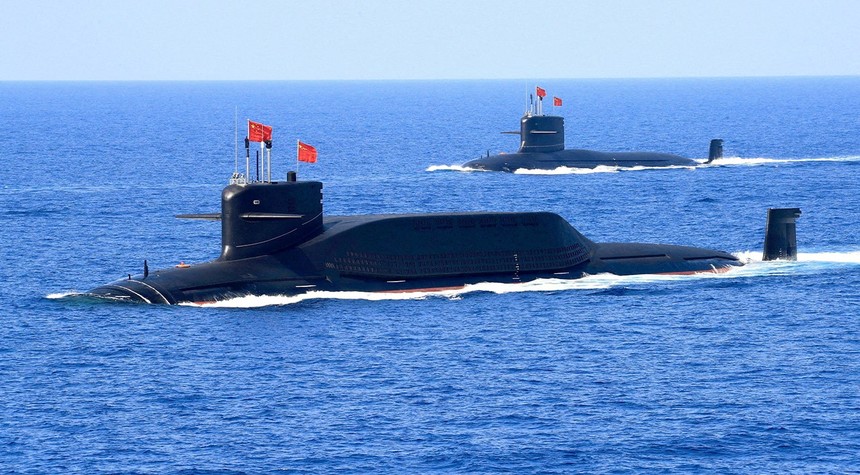
The strategic balance of power in the Pacific faces a sobering new challenge as evidence mounts that Russia and China have entered into a dangerous technology exchange that threatens American military superiority at sea.
Retired Rear Admiral Mark Montgomery has disclosed that Moscow appears to be providing Beijing with advanced submarine-quieting technology in exchange for Chinese support of Russia’s ongoing military operations. This revelation carries profound implications for American naval dominance and the security of Taiwan.
The technology in question reduces a submarine’s acoustic signature, making it substantially more difficult to detect and track. For decades, the United States Navy has maintained a decisive advantage in undersea warfare, relying on superior technology and stealth capabilities to monitor and counter potential adversaries. That advantage now faces erosion.
“Russia is giving incredibly important technology to China. They’re allegedly giving them submarine quieting technology,” Montgomery stated. The retired admiral, co-author of the recently published “Axis of Aggressors,” emphasized the gravity of this development. “Any weakening of our asymmetric advantage in undersea warfare is a big deal.”
China has long struggled with submarine propulsion and noise reduction, even as it has rapidly expanded and modernized its naval fleet. Russian assistance in this critical area could help Beijing narrow a technological gap that has favored American forces for generations. In a potential conflict over Taiwan, the ability to detect and track Chinese submarines would prove essential to American and allied operations.
The Chinese Embassy responded to inquiries with carefully crafted language that neither confirmed nor denied the technology transfer. “Military cooperation between China and Russia consistently adheres to the principles of non-alliance, non-confrontation, and non-targeting of third parties,” the embassy stated, characterizing the relationship as defensive in nature and beneficial to regional stability.
This characterization rings hollow when examined against the broader context of the relationship. China has become a crucial lifeline for Russia’s war effort, providing economic support and materials that have helped Moscow sustain its military operations. In return, Russia appears willing to share technology that could directly threaten American interests and those of our allies in the Pacific.
The exchange represents more than a simple transaction between two nations. It signals the formation of what Montgomery terms an “Axis of Aggressors,” a coordinated effort by authoritarian powers to undermine American military advantages and challenge the international order that has maintained relative peace since the Second World War.
The implications extend beyond submarine technology. Reports suggest Russia may also be sharing advanced missile and airborne systems with China, further enhancing Beijing’s capabilities across multiple domains of warfare.
For American policymakers and military planners, these developments demand urgent attention. The Navy’s submarine force has long served as a cornerstone of American power projection and deterrence in the Pacific. Any degradation of that capability could embolden Chinese aggression toward Taiwan and destabilize the entire region.
The situation underscores a fundamental truth about the current international landscape. The world’s authoritarian powers are not operating in isolation. They are actively collaborating, sharing technology and resources in a coordinated effort to challenge American strength and influence.
That is the way it is, and that is what America must now confront.
Related: Putin Threatens European Shipping as Ukraine Strikes Major Russian Port