
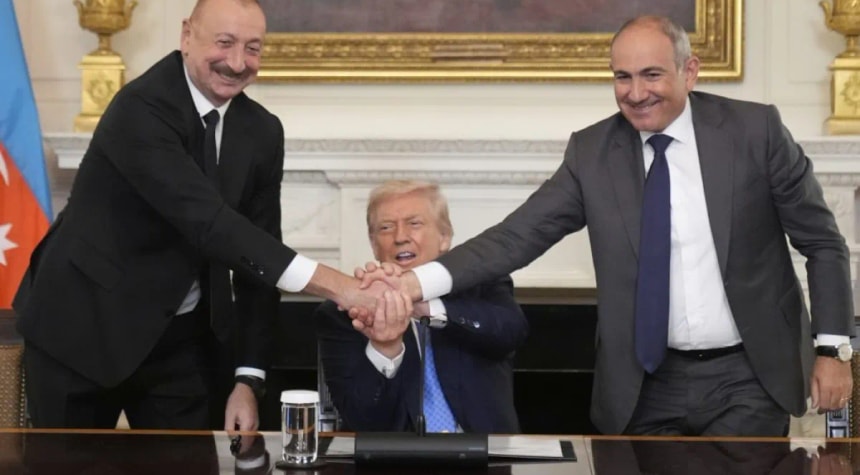
Construction has commenced on the Trump Route for International Peace and Prosperity, marking a significant milestone in American efforts to reshape the geopolitical landscape of the Caucasus region. President Donald Trump offered his congratulations to Armenia this week as groundbreaking ceremonies launched the ambitious infrastructure project that stands as the centerpiece of a historic peace agreement between Armenia and Azerbaijan.
The peace accord, signed at the White House in August 2025, brought together Armenian Prime Minister Nikol Pashinyan and Azerbaijani President Ilhan Aliyev to formally end a conflict over the Nagorno-Karabakh region that has consumed the two nations for more than three decades. Where previous administrations and international mediators failed to broker lasting peace, the Trump administration succeeded by offering something tangible: a United States-operated corridor that would connect Azerbaijan with its isolated Nakhchivan exclave while simultaneously drawing Armenia into closer partnership with Washington.
In a video address to the Armenian people, President Trump characterized the groundbreaking as an "unbelievably exciting occasion" and praised Prime Minister Pashinyan for his courage in choosing peace. The president noted that for more than thirty-five years, the conflict had caused enormous suffering, and many had attempted without success to resolve it.
The project, which had experienced delays in its development phase, represents more than simple infrastructure. It establishes vital overland trade routes connecting Armenia, Turkey, Azerbaijan, and ultimately serving American strategic interests in a region long dominated by Russian influence. For Turkey, the route provides reliable access to the broader Turkic world without dependence on Iran or Russia. For the United States, it represents both economic opportunity and a dramatic expansion of influence in what has traditionally been considered Russia’s sphere.
Armenian state television broadcast footage of construction vehicles beginning work at the site of an old Soviet-era tunnel that will form part of the corridor. Additional equipment and materials stood ready as crews commenced the initial phases of what promises to be an extensive engineering undertaking.
The strategic implications of this development extend well beyond regional commerce. Armenia, historically aligned so closely with Russia as to function almost as a protectorate, has pivoted decisively toward Washington. The transformation of Armenia and Azerbaijan into American partners marks a contested challenge to Russian dominance in its traditional backyard.
Critical minerals figure prominently in the American calculus. A framework agreement signed in May between the United States and Armenia emphasized that trade in these strategic materials would flow through the new corridor, addressing a priority concern for American economic and national security interests.
Not all regional powers view this development favorably. Iran, which has maintained historically close ties with Armenia, has responded to the project with increasing alarm and hostility. Mohammad Mokhber, a senior adviser to Iranian Supreme Leader Ayatollah Mojtaba Khamenei, issued what can only be interpreted as a threat against the corridor’s operation. He dismissed what he termed "fake routes" and warned that Iran’s geopolitical interests in the region constitute a red line that will not be crossed. His reference to the Strait of Hormuz carried unmistakable implications.
President Trump concluded his address by extending an invitation to Prime Minister Pashinyan to attend next year’s National Prayer Breakfast in Washington, noting Armenia’s historic distinction as the world’s first Christian nation. Both Pashinyan and President Aliyev issued statements expressing gratitude for the American president’s commitment to the project.
The progress on this infrastructure initiative offers Armenia some consolation following President Trump’s recent announcement restricting data center construction to United States territory, a decision that disappointed Armenian hopes for technology sector development as a means of strengthening bilateral relations.
And that is the way it is.
Related: Iranian Singer Receives 74 Lashes for Performing Without Mandatory Head Covering