
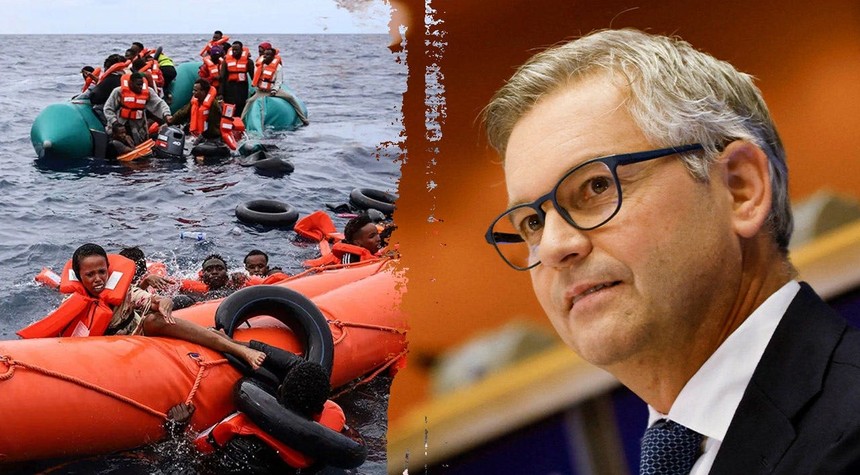
The European Union has acknowledged what critics have long asserted: for the better part of a decade, the bloc exercised virtually no meaningful control over who entered its borders or who departed after being ordered to leave.
European Commissioner for Internal Affairs and Migration Magnus Brunner made the admission this week in Washington, stating plainly that ten years ago, the EU “didn’t have a system” and “didn’t have control over what is happening and who would come into the European Union and who would have to leave again.”
The acknowledgment comes as Brussels prepares to implement sweeping new asylum rules in June, designed to restore order to a migration system that has failed by nearly every measurable standard. According to data from Eurostat, only approximately one-quarter to one-third of migrants ordered to leave the European Union are actually returned to their countries of origin. The remainder stay in Europe, regardless of their legal status.
Brunner told reporters that deportation rates have improved somewhat in recent years, rising from roughly twenty percent to nearly thirty percent. Yet even by the commissioner’s own accounting, seventy percent of those ordered to leave remain on European soil. For a union of sovereign nations numbering nearly 450 million citizens, this represents a fundamental failure of governmental authority.
The new migration and asylum pact represents an attempt to address these enforcement gaps through accelerated asylum decisions, increased processing at external borders, and expanded mechanisms for returning those without legal grounds to remain. Whether these measures prove sufficient remains an open question.
The migration crisis has strained relations across the Atlantic. President Donald Trump has repeatedly characterized mass migration as “destroying” Europe and described the influx as a “horrible invasion.” Secretary of State Marco Rubio has similarly criticized what he terms “open borders” policies, while Vice President JD Vance has warned that Europe risks what he called “civilizational suicide” if border control is not restored.
These are not merely rhetorical flourishes. High-profile crimes involving migrants have generated significant public concern across European nations, and the political pressure has become impossible for Brussels to ignore. National governments have demanded greater authority to deport those who commit crimes on their soil, a clear indication that member states no longer trust the central bureaucracy to manage the problem effectively.
President Trump also reflected this week on King Charles’ recent visit to Washington, expressing hope that the royal engagement might improve relations between the United States and the United Kingdom, despite ongoing tensions with Prime Minister Keir Starmer over Iran policy.
The European migration situation serves as a case study in the consequences of policy detached from enforcement capability. For years, European leaders maintained generous asylum policies while lacking the administrative infrastructure to process claims efficiently or remove those whose applications were denied. The result has been precisely what critics predicted: a system that rewards illegal entry and punishes those who follow legal immigration procedures.
As June approaches and the new rules take effect, the fundamental question remains whether Brussels possesses the political will to enforce its own laws. Acknowledging past failures represents progress, but only if followed by meaningful action. The citizens of Europe, and their elected representatives, are watching closely.
Related: China Deploys Robotic Wolf Packs in Preparation for Potential Taiwan Invasion