
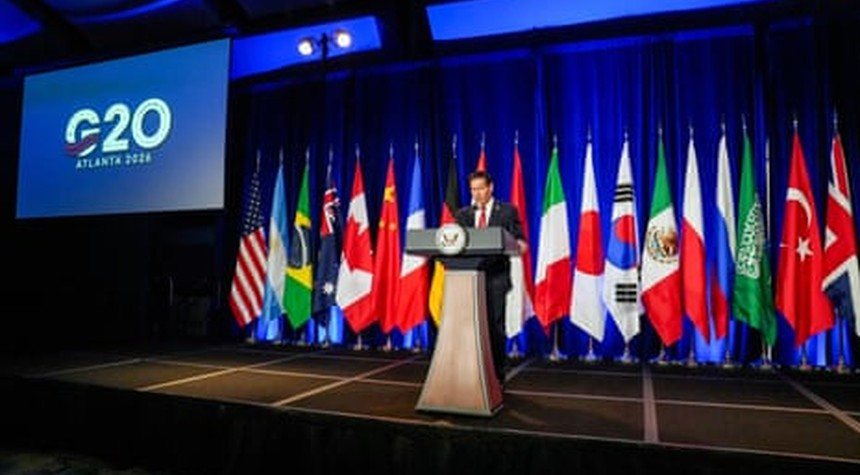
The familiar ritual that opens gatherings of the world’s most powerful nations did not occur in Atlanta this week. There would be no group photograph at the G20 foreign ministers meeting, a small but telling indicator of the deep fractures now defining international diplomacy.
Secretary of State Marco Rubio made the decision to cancel the traditional opening photo after approximately one-third of the participating countries indicated they would not stand beside Russian Foreign Minister Sergei Lavrov. The list of objecting nations included Australia, the United Kingdom, and several European Union member states.
This is the state of international relations in 2025: major democratic powers refusing even to appear in a photograph with Russian representatives while the current administration pursues a policy of reintegrating Moscow into the global community.
Despite the cancelled photo, Rubio proceeded with opening remarks that called for unity among nations facing what he termed interconnected economic and geopolitical crises. “We are in a critical moment,” he told the assembled foreign ministers. The irony of appealing for unity while the gathering could not manage a simple group photograph was apparently lost on no one present.
Germany’s foreign affairs minister, Johann Wadephul, had made his country’s position clear before arriving in Atlanta. There would be no family photo including European partners and Lavrov, he said, because there is no normality with Russia. British Foreign Secretary Ed Miliband echoed this stance, noting that the United Kingdom has not engaged with Russia in such symbolic ways for several years.
Australia’s Foreign Minister Penny Wong delivered perhaps the most direct rebuke during the opening session, condemning Russia’s invasion of Ukraine as brutal and unjustified while Lavrov sat in attendance. She outlined how Russia’s illegal war has disrupted international markets and worsened global food security. Her office later supported the American decision to cancel the photograph, stating that Australia would not normalize Russia’s actions in Ukraine.
The divisions extend beyond the question of Russia. Disagreements also include Poland’s potential membership in the G20, which Russia opposes, and the Trump administration’s decision not to invite South Africa, a current G20 member, over what officials described as objections from other participating nations.
These conflicts have led diplomats to predict that the foreign ministers will be unable to produce a joint communiqué when the meetings conclude. Such statements typically represent the minimum consensus among participating nations. That even this modest goal appears unattainable speaks to the current state of international cooperation.
Polish Deputy Prime Minister and Foreign Minister Radosław Sikorski, attending his country’s first G20 meeting as a guest, seemed unsurprised by the dysfunction. With wars ongoing and participants in those wars sitting at the same table, reaching agreement becomes exceedingly difficult, he observed.
Diplomats present described the opening session as cordial in manner, but noted that Russia’s position on Ukraine remains unyielding. And that, perhaps, is the essential fact: nearly three years into a devastating war, the international community remains as divided as ever on how to respond to Russian aggression, even as some seek to restore normal diplomatic relations with Moscow.
The absent photograph tells its own story about the fractured state of global diplomacy and the challenges facing any effort to restore consensus among nations whose interests increasingly diverge.
Related: United States Issues Stark Warning to Iran as G20 Ministers Gather in Atlanta