
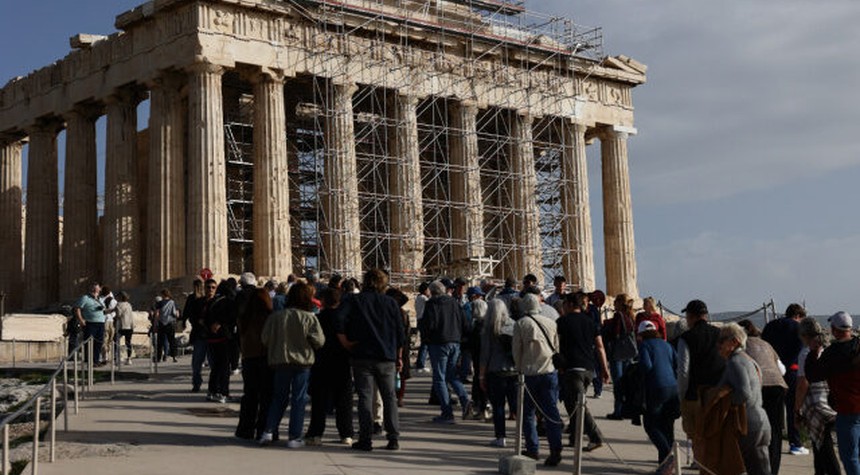
ATHENS, Greece — In the marble halls of the Greek Health Ministry, a senior government official has extended an unusual diplomatic appeal to President Donald Trump, one that reaches across two centuries of international dispute and touches the very foundations of Western civilization.
Adonis Georgiadis, vice president of Greece’s governing New Democracy party and the nation’s Health Minister, believes the American president holds the key to resolving one of Europe’s most enduring cultural controversies. The issue concerns the return of ancient Parthenon sculptures, removed from Athens more than two hundred years ago and currently housed in the British Museum.
The sculptures in question were taken by Thomas Bruce, the seventh Earl of Elgin, during the Ottoman Empire’s occupation of Greece in the early nineteenth century. Greeks refer to them simply as “The Marbles” or the “Parthenon Marbles,” pointedly avoiding any association with Lord Elgin, whom they regard as a thief rather than a collector.
The circumstances surrounding their removal remain disputed to this day. What is certain is that these ancient works, created during the golden age of classical Athens, have been separated from their original home for generations while successive Greek governments have sought their return.
Georgiadis, who is also a historian, framed the matter in terms he believes will resonate with an American president. He noted that the founding fathers of the United States held profound respect for ancient Greece and Rome, drawing upon classical republican principles when crafting American democracy.
“President Trump, as the natural leader of the Western world, realizes that representing the spirit of the American grandfathers of your democracy,” Georgiadis said during an interview earlier this year. He expressed confidence that Trump could press the British government to make what he termed “the right move.”
The Greek official emphasized that support for repatriation extends well beyond Greece’s borders. “Not even one educated person in the world does not realize why the marbles should come back,” he stated, suggesting the issue transcends partisan politics and national boundaries.
Notably, even Turkey, the successor state to the Ottoman Empire that once occupied Greece, supports the Greek position on this matter. This rare alignment between historical adversaries underscores the broad consensus Georgiadis describes.
According to the Health Minister, British resistance to returning the sculptures has softened considerably over time. “The British are not saying ‘We will never give them back,'” he explained. “They just say, ‘Let us see if it is the right time.’ A real argument that they possess them legitimately is not even raised from their side.”
This represents a significant shift from earlier British positions. Georgiadis noted that when Lord Elgin first brought the marbles to Britain, he faced accusations of theft from his own countrymen.
For Greeks, the return of the Parthenon sculptures carries weight comparable to defending the national anthem in the United States. It represents not merely the recovery of ancient artifacts, but the restoration of national heritage and cultural dignity.
The appeal to President Trump represents a calculated diplomatic gambit. By framing the issue in terms of Western civilization and lasting historical legacy, Greek officials hope to engage an American president who has shown interest in leaving his mark on history.
Whether this approach will succeed remains to be seen. The British Museum has long maintained that the sculptures are better preserved and more accessible to global audiences in London than they would be in Athens. Yet as Georgiadis suggests, the tide of international opinion may be shifting.
And that is the way it is.
Related: Trump Warns of Military Action Against Iran if Nuclear Negotiations Collapse