
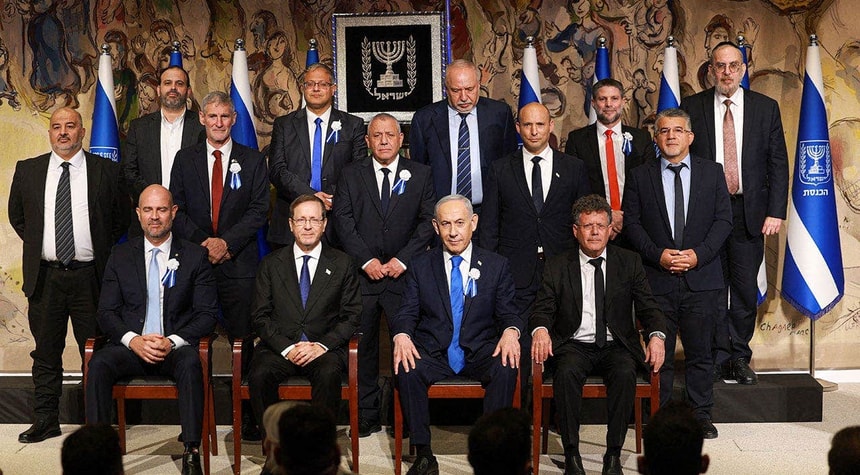
Israel’s newly elected parliament convened Tuesday for its swearing-in ceremony, beginning what may prove to be one of the most consequential political transitions in the nation’s history. Yet the ceremony itself resolved nothing. Israel remains without a government, and the path to forming one grows more complex by the day.
Former Israeli military chief Gadi Eisenkot received the mandate from President Isaac Herzog on Sunday to assemble the next governing coalition. Sixty-seven lawmakers recommended him for the position, compared with forty-six who supported Prime Minister Benjamin Netanyahu. This represents a significant vote of confidence, though translating that support into a functioning government presents formidable challenges.
Eisenkot’s Yashar party secured twenty-one seats in the October 27 election. He is working in close coordination with former Prime Minister Naftali Bennett, whose B’Yachad party, formed in partnership with former Prime Minister Yair Lapid, won twelve additional seats. While the two parties have not merged, their cooperation provides Eisenkot with the backing of thirty-three lawmakers. This exceeds Netanyahu’s Likud, which remains the largest single party with twenty-seven seats but finds itself in an increasingly vulnerable position.
According to sources familiar with the negotiations, Bennett has chosen to serve as a political kingmaker rather than seek the premiership himself. He intends to coordinate closely with Eisenkot while maintaining his party’s independent identity. This arrangement strengthens Eisenkot’s hand considerably, though it does not guarantee agreement on every coalition decision.
The swearing-in ceremony Tuesday exposed the deep divisions that complicate government formation. Netanyahu called for a national unity government, citing Israel’s security challenges. Yet he simultaneously launched sharp attacks against Arab parties, accusing them of supporting terrorism and warning against forming a government dependent on their votes.
Bennett, who has largely remained silent during coalition negotiations, broke that silence to confront Netanyahu directly during his address. He questioned Netanyahu about allegations of financial ties to Qatar among members of the prime minister’s inner circle. Bennett also demanded to know why Netanyahu had not established a state commission of inquiry into the October 7, 2023 Hamas attacks and challenged him to declare Qatar an enemy state. The exchange devolved into shouting among multiple lawmakers as Netanyahu continued his speech.
Eisenkot responded with unusual force. In a statement, he described Netanyahu’s address as delusional, divisive, hate-filled and shameful. He declared himself more convinced than ever that Netanyahu was unfit to remain in office for even one more minute. Eisenkot subsequently instructed his negotiating team to cancel a meeting scheduled with Likud representatives for Wednesday.
Despite this public confrontation, a national unity government remains under consideration. Such an arrangement would require Netanyahu to agree not to serve as prime minister first, potentially allowing Eisenkot to lead under a rotation agreement while Netanyahu assumes the position of alternate prime minister. Whether Netanyahu would accept such terms remains an open question.
The mathematics of coalition building explain why this process has become so complicated. The official election results gave Netanyahu’s bloc fifty-three seats, while the four parties seeking to replace him secured forty-eight. The remaining nineteen seats went to two Arab-led parties: the Joint List with eleven seats and Ra’am, led by Mansour Abbas, with eight.
While sixty-seven lawmakers supported giving Eisenkot the mandate, that support does not automatically translate into a workable governing coalition. President Herzog acknowledged this challenge during consultations with parliamentary leaders, citing disagreements and mutual political vetoes that could prevent either side from forming a stable government.
Eisenkot’s principal partners are Bennett, Lapid, Yair Golan of the Democrats and Avigdor Liberman of Yisrael Beytenu. Together their parties hold forty-eight seats, thirteen short of the sixty-one generally needed for a parliamentary majority.
Eisenkot has outlined four principles for potential coalition partners: recognizing Israel as a Jewish and democratic state, accepting the values of the Declaration of Independence, and supporting fundamental democratic norms. These principles may limit his options but also provide clarity about the government he intends to lead.
Israel now enters a period of intensive negotiation with its political future hanging in the balance. And that, as they say, is the way it is.
Related: Air France Pilot Makes Unapproved Turn, Bringing Aircraft Within 400 Feet of American Airlines Jet