
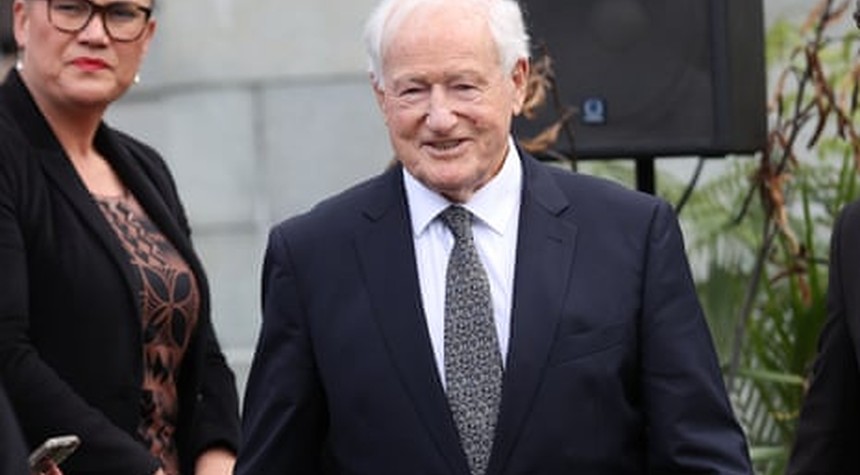
Former New Zealand Prime Minister Jim Bolger, whose seven-year leadership transformed his nation’s economic and social landscape, died peacefully on Wednesday at age 90. The veteran statesman, surrounded by his wife Joan, nine children, and eighteen grandchildren, succumbed following complications from kidney failure that began last year.
Bolger’s tenure as Prime Minister from 1990 to 1997 marked a period of significant change in New Zealand’s history, characterized by both controversial economic reforms and groundbreaking reconciliation efforts with the indigenous Māori people.
His administration implemented what became known as the “mother of all budgets” in 1991, a sweeping reform package that dramatically reduced government spending on welfare and healthcare. While these measures proved deeply unpopular and nearly cost his National Party the subsequent election, they fundamentally reshaped New Zealand’s economic framework.
Perhaps Bolger’s most enduring legacy lies in his commitment to addressing historical injustices against the Māori people. His government established the first meaningful settlements between Māori tribes and the state, creating a framework for reconciliation that continues to influence New Zealand’s social fabric today.
The former prime minister’s political evolution proved remarkable. In recent years, Bolger publicly reconsidered his earlier embrace of neoliberal policies, acknowledging in 2017 that the economic model had failed to deliver broad-based prosperity, instead concentrating wealth among a select few.
Before his premiership, Bolger entered parliament in 1972 and rose to lead the National Party in 1986. After leaving office, he served as New Zealand’s ambassador to the United States from 1998 to 2002, further strengthening ties between the two nations.
Current Prime Minister Christopher Luxon praised Bolger as a “principled and formidable colleague” who maintained respectful relationships even with political opponents. Opposition Leader Chris Hipkins highlighted Bolger’s capacity for reflection and his later-life advocacy against growing social inequality.
Bolger’s administration also introduced the mixed-member proportional electoral system, a reform that fundamentally altered New Zealand’s political landscape and remains in place today. This change, combined with his pioneering work on Māori reconciliation and economic restructuring, ensures his place as one of New Zealand’s most consequential modern leaders.
As the nation reflects on Bolger’s legacy, it remembers a leader who, despite implementing controversial policies, maintained a reputation for personal warmth and an unwavering commitment to his vision of a better New Zealand. His willingness to later question his own decisions and adapt his views demonstrated a rare quality in modern politics: the capacity for growth and self-reflection in service of the greater good.