
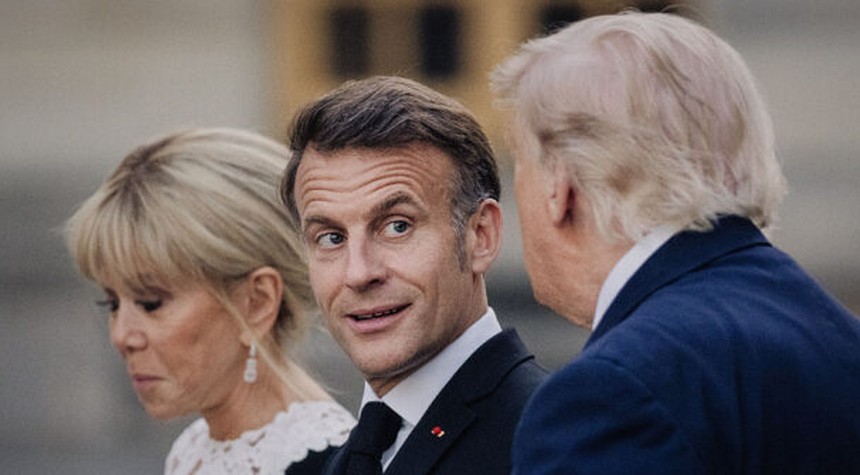
French President Emmanuel Macron launched a sharp rebuke against foreign leaders this week, dismissing international commentary on the sustained civil unrest gripping French cities as “stupid” and “unacceptable.” The remarks came during a diplomatic visit to Doha, Qatar, where the French leader appeared visibly agitated when pressed about observations from abroad regarding weeks of rioting across France.
The president’s comments have been widely interpreted as directed toward U.S. President Donald Trump and Israeli Prime Minister Benjamin Netanyahu, both of whom have noted the apparent connection between France’s immigration challenges and the ongoing violence. Macron categorically rejected such assessments, insisting that claims of France being “overrun by hordes of migrants and Islamists” are “completely false.”
In what observers describe as an increasingly defensive posture, President Macron attributed international criticism to “foreign manipulation of information,” including the spread of artificial intelligence-generated images that he claimed have distorted foreign perceptions of the crisis. The French leader went further, suggesting that some political figures are “running their campaigns at France’s expense” by acknowledging realities on the ground in French cities.
“There are people who are campaigning in our own region or on the other side of the Atlantic who are echoing narratives that certain circles want to propagate about what happened in France,” Macron stated. He concluded with a stark declaration: “All people who speak ill of our country are people who don’t love France.”
The riots in question have included serious incidents, among them an alleged hard-left attack on a city hall now under investigation by French counter-terrorism authorities. Yet Macron appears unwilling to entertain the possibility that friendly foreign leaders might express legitimate concern for a valued European ally facing domestic turmoil.
The French president’s isolation on this matter extends beyond the Atlantic. Even within Europe, leaders traditionally aligned with centrist positions have begun acknowledging what many consider self-evident. German Chancellor Friedrich Merz, a center-right figure from the same party as former Chancellor Angela Merkel, told reporters this week that the violence is “most likely” the result of “non-integrated people” stemming from migration policies.
This represents a significant shift in European political discourse. When even moderate voices like Merz feel compelled to address the integration challenges facing Western European nations, it suggests the issue has moved beyond partisan talking points into the realm of observable reality.
Poland and Hungary, despite recent electoral transitions away from right-wing populist governments, have maintained their skepticism of open migration policies. The new, more European Union-friendly administrations in both nations have notably refrained from endorsing Macron’s characterization of events.
The French president’s strategy of deflecting domestic criticism by attacking foreign observers is not new. Throughout these riots, Macron has repeatedly attempted to redirect attention away from France’s internal challenges and toward international commentary about those challenges.
However, this approach faces mounting difficulty as the evidence before the world’s eyes contradicts the narrative emanating from Paris. When city halls come under assault, when counter-terrorism units must investigate domestic incidents, and when even allied governments acknowledge integration failures, dismissing all criticism as the work of enemies becomes an increasingly untenable position.
The question facing France and its European neighbors is whether political leaders will acknowledge the challenges before them or continue to attack those who point them out. For President Macron, the choice appears clear, even as his position grows more isolated with each passing day.
Related: Russia and Ukraine Agree to US-Mediated Peace Negotiations