
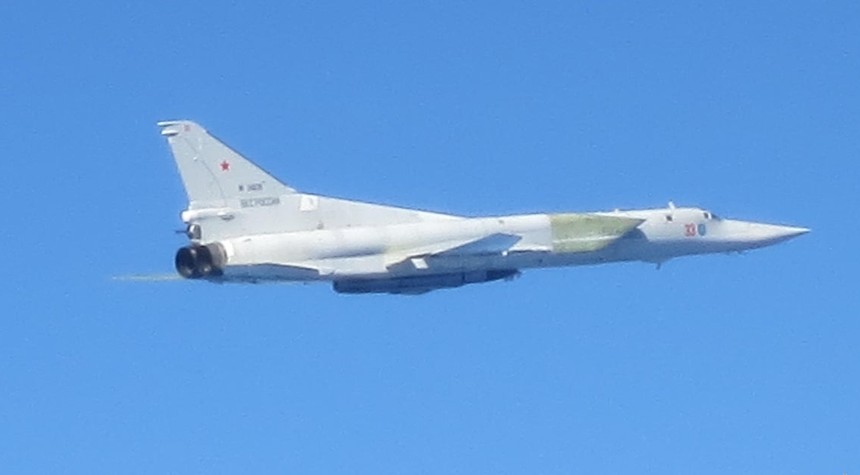
NATO fighter aircraft intercepted a substantial formation of Russian strategic bombers and escort fighters over the Baltic Sea on Monday, marking another chapter in the ongoing military chess match along the alliance’s eastern frontier.
The intercept operation involved French Rafale fighters deployed from Lithuania, joined by aircraft from Sweden, Finland, Poland, Denmark, and Romania. The multinational response underscored the heightened state of readiness that has characterized the Baltic region since the expansion of NATO’s eastern membership.
According to the French detachment statement, the Russian formation consisted of two supersonic Tu-22M3 strategic bombers accompanied by approximately ten fighter aircraft, including both SU-30 and SU-35 variants, which rotated escort duties throughout the mission. The Rafale fighters, armed with air-to-air missiles, maintained visual contact with the Russian aircraft throughout their flight path.
The Russian Defense Ministry characterized the operation as a scheduled training mission conducted over international waters, emphasizing compliance with established aviation protocols. The flight lasted more than four hours, the ministry reported, and occurred entirely within airspace over neutral waters of the Baltic Sea.
“Crews of long-range aviation regularly conduct flights over the neutral waters of the Arctic, the North Atlantic, the Pacific Ocean, as well as the Baltic and Black Seas,” the ministry stated. “All flights of Russian Aerospace Forces aircraft are carried out in strict compliance with international rules for the use of airspace.”
Such encounters have become routine fixtures in the Baltic theater. The Russian Defense Ministry documented similar bomber flights in January of this year, which also prompted NATO responses, and at least four comparable missions occurred throughout the previous year.
NATO maintains a continuous air policing presence over the Baltic states, a commitment dating back to when Lithuania, Latvia, and Estonia joined the alliance. The mission reflects the strategic vulnerability of these nations, which lack the resources to maintain their own round-the-clock air defense capabilities.
The alliance routinely scrambles fighter aircraft when Russian military planes approach NATO airspace. According to NATO procedures, these intercepts serve primarily as identification missions, particularly necessary because Russian military aircraft frequently operate without activated transponders, maintain radio silence with civilian air traffic controllers, and fail to file standard flight plans.
This latest incident occurred while international attention remains focused on developments in the Middle East, yet it serves as a reminder that European security concerns persist regardless of global headlines. The Baltic Sea region remains a critical junction point where NATO and Russian military forces operate in close proximity, requiring constant vigilance and professional military conduct from both sides.
The coordinated response involving six NATO member nations demonstrated the alliance’s integrated air defense capabilities and the operational readiness of forces stationed along the eastern flank. The participation of recently admitted members Sweden and Finland in the intercept operation particularly highlights the expanded defensive depth NATO now enjoys in the Baltic region.
Neither NATO’s Allied Air Command nor the Russian Defense Ministry provided additional commentary beyond their initial statements regarding Monday’s encounter.
Related: Rubio Announces Sanctions Against Ortega Regime Official Over Rights Abuses