
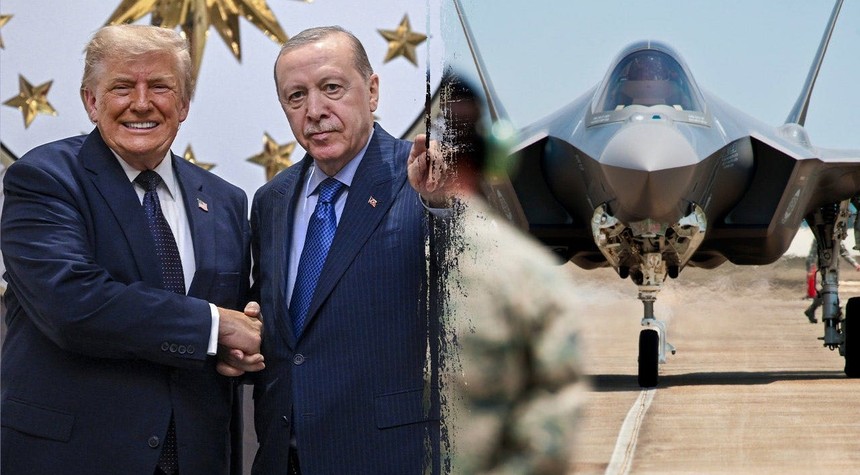
President Donald Trump announced Tuesday that the United States will lift sanctions against Turkey and expressed willingness to proceed with the sale of F-35 stealth fighter jets to the NATO ally, marking a significant shift in American foreign policy toward Ankara.
The announcement came during a bilateral meeting with Turkish President Recep Tayyip Erdoğan at the NATO summit in Ankara. The decision represents a dramatic reversal of the position maintained by previous administrations, which had expelled Turkey from the F-35 program following its 2019 purchase of the Russian S-400 missile defense system.
“I can tell you we’re going to be taking the sanctions off,” President Trump stated plainly during the meeting. “I don’t want him to waste his time answering that question. It’s time. We don’t sanction friends.”
The sanctions in question targeted Turkey’s defense sector and were imposed as punishment for Ankara’s acquisition of Russian military equipment. The S-400 system has long been viewed by American defense officials as incompatible with NATO operations and potentially capable of gathering intelligence on the F-35’s advanced capabilities.
Turkey’s removal from the F-35 program several years ago created significant friction within the alliance. The country had been both a customer and a manufacturing partner in the multinational fighter jet program, with Turkish companies producing various components for the aircraft. The expulsion disrupted supply chains and strained diplomatic relations between Washington and Ankara.
The timing of this policy shift coincides with a reassessment of Turkey’s strategic importance to Western interests. As a NATO member controlling access to the Black Sea and maintaining a substantial military force, Turkey occupies a critical geographic position at the crossroads of Europe, Asia, and the Middle East.
President Trump’s characterization of Turkey as a friend rather than an adversary reflects his administration’s pragmatic approach to alliance management. The decision suggests a calculation that maintaining strong ties with Ankara outweighs concerns about its defense procurement choices, particularly regarding Russian-made systems.
The move will likely face scrutiny from defense analysts and some members of Congress who have consistently opposed any accommodation of Turkey’s S-400 acquisition. Critics have argued that allowing Turkey back into the F-35 program while retaining Russian air defense systems creates an unacceptable security risk.
However, supporters of engagement with Turkey point to the country’s cooperation on various regional issues and its role as a buffer against instability emanating from the Middle East. Turkey’s recent diplomatic activities and its position regarding conflicts in Syria and elsewhere have demonstrated its continued relevance to American strategic interests.
The practical implementation of this policy change will require coordination between the Pentagon, the State Department, and defense contractors involved in F-35 production. Questions remain about the timeline for sanctions removal and whether Turkey will resume its previous role in the fighter jet program’s supply chain.
This development represents one of the more consequential foreign policy decisions of President Trump’s current term, with implications extending beyond bilateral relations to affect the broader dynamics within NATO and the balance of power in the eastern Mediterranean region.
Related: Congressional Report Reveals Alleged Discrimination Against U.S. Firms in South Korea