
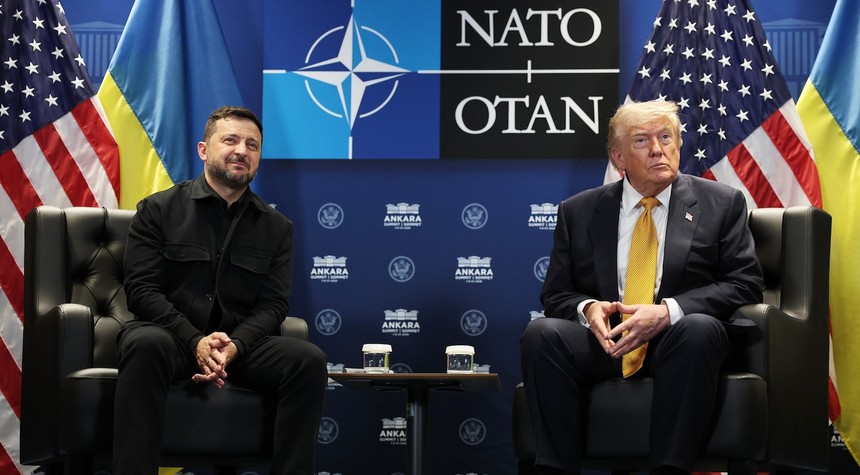
President Donald Trump announced Wednesday that the United States will grant Ukraine a license to manufacture Patriot air defense systems domestically, a significant development as the embattled nation confronts severe ammunition shortages in its ongoing conflict with Russia.
The announcement came during a bilateral meeting with Ukrainian President Volodymyr Zelenskyy at the NATO summit in Ankara, Turkey. The president’s proposal represents an acknowledgment of the stark reality facing both nations: current production of these critical defense systems cannot meet the demands created by modern warfare.
“One of the things we’re going to be talking about is, you’ll receive a license to make Patriots,” Trump told Zelenskyy. “This way he can’t complain that we’re not giving him enough. I said, ‘Make them yourself.'”
The president candidly noted that the company manufacturing Patriot systems has not yet been informed of this decision, though he expressed confidence the matter would be resolved satisfactorily.
When pressed on whether the United States would provide Patriot interceptors to Ukraine during the interim period while production capabilities are established, Trump acknowledged American limitations. “We have Patriots, but we don’t have that many. We need them for ourselves, too,” the president stated.
This admission underscores a critical challenge facing Western defense capabilities. The expenditure of Patriot PAC-3 interceptor missiles in Ukraine and the Middle East has dramatically exceeded current production capacity, creating what defense analysts describe as a global shortage. As the Russia-Ukraine conflict enters its fifth year, this shortfall has become increasingly consequential.
Zelenskyy addressed this urgent need at a defense industry forum during the summit. “We need to find a way to get as quick as possible, as much as possible, missiles for Patriot systems. This is the most important thing,” he emphasized.
Russia has exploited this vulnerability through concentrated bombardments combining ballistic missiles and drone swarms, overwhelming Ukrainian defenses and resulting in substantial civilian casualties. In his address to NATO members, Zelenskyy characterized Russian ballistic missiles as Moscow’s “last major advantage” and urged European nations to develop independent production capabilities.
“We all value the Patriot system. It’s an excellent system,” Zelenskyy stated. “But today’s wars have shown current Patriot production is not enough to meet the growing demand for protection against ballistic missiles. That is a fact.”
Despite these challenges, Trump projected optimism regarding potential resolution of the conflict. “I think we’re getting much closer than people realize, and President Putin wants it to end,” the president said Monday. “And President Zelenskyy actually wants it to end now.”
The president also characterized the conflict as primarily a European concern, stating “it doesn’t affect us” and suggesting the burden of resolution should fall more heavily on European shoulders.
Zelenskyy, for his part, expressed gratitude for American assistance. “Mr. President, thank you very much for this meeting. And we’re thankful, as always, to your support, American support, bipartisan support,” he said.
The licensing agreement represents a pragmatic approach to a vexing problem. Rather than continuing to deplete American stockpiles or accelerating domestic production beyond current capacity, the administration has chosen to enable Ukrainian self-sufficiency. Whether this strategy proves effective will depend largely on how quickly Ukraine can establish manufacturing capabilities while managing immediate defense requirements.
Related: Australian and Solomon Islands Leaders Challenge Beijing Over ICBM Launch