
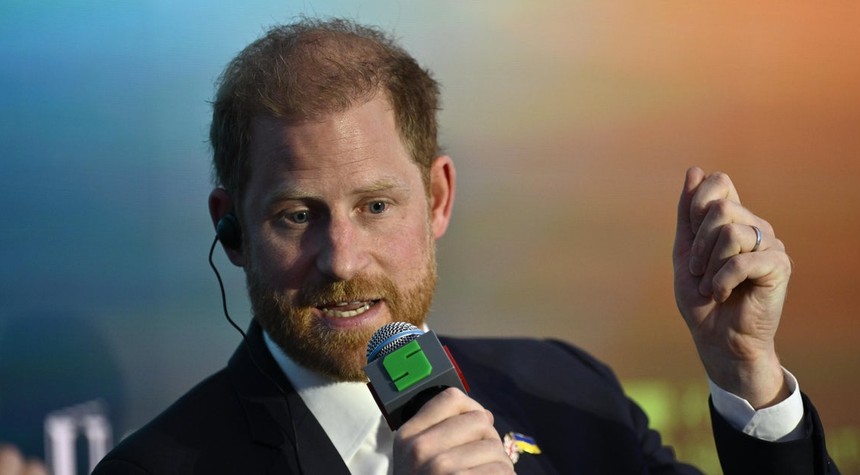
Prince Harry arrived in Kyiv Thursday for an unannounced visit to demonstrate solidarity with Ukraine, marking his third journey to the embattled nation since Russia’s full-scale invasion began three years ago.
Speaking at the Kyiv Security Forum, the Duke of Sussex delivered pointed remarks directed at Washington, emphasizing America’s historical obligations to Ukrainian sovereignty. His comments drew a swift response from President Trump and highlighted growing tensions over Western support for Ukraine’s defense.
“The United States has a singular role in this story not only because of its power but because when Ukraine gave up nuclear weapons, America was part of the assurance that Ukraine’s sovereignty and borders would be respected,” Harry stated. “This is a moment for American leadership, a moment for America to show that it can honor its international treaty obligations, not out of charity but out of its own enduring role in global security and strategic stability.”
The prince’s reference to the 1994 Budapest Memorandum, in which Ukraine surrendered its nuclear arsenal in exchange for security assurances from the United States, Britain, and Russia, underscores a fundamental question facing American foreign policy. That agreement now stands as a test case for the credibility of American commitments abroad.
President Trump responded to Harry’s remarks later Thursday at the White House with characteristic directness. “How’s he doing? How’s his wife? Please give her my regards,” Trump said. “I know one thing, Prince Harry is not speaking for the United Kingdom, that’s for sure. I think I am speaking for the United Kingdom more than Prince Harry.”
The exchange reveals the complex dynamics at play as European leaders seek to maintain American engagement in Ukraine’s defense while the Trump administration pursues a different approach to the conflict.
Harry praised European nations for their substantial support of Ukraine but urged greater urgency in delivering assistance. “Europe has stood up in profound ways. And that support has mattered, and Ukraine knows it,” he said. “The task now is to match endurance with speed.”
The prince framed the conflict in stark ideological terms, describing it as a fundamental contest between liberal democracies and authoritarian regimes. He drew particular attention to Russia’s systematic deportation of Ukrainian children, which international observers have documented extensively.
“Under international law, this forcible transfer of children from one national group to another is not just a war crime. It can constitute an act of genocide when carried out with intent to destroy a people’s identity,” Harry stated. He characterized this policy as evidence of a clear moral divide between Ukraine’s adherence to international law and Russia’s disregard for it.
The distinction Harry drew speaks to broader questions about the rules-based international order that has governed relations among nations since World War II. Whether that order can withstand challenges from authoritarian powers may well depend on how democratic nations respond to Ukraine’s defense.
Harry’s visit comes at a critical juncture as Ukraine enters its fourth year of full-scale war with Russia. The outcome of this conflict will shape European security for generations and test whether international agreements carry weight in an era of renewed great power competition.
Related: Greek Prime Minister Urges Diplomatic Resolution to US-Iran Standoff