
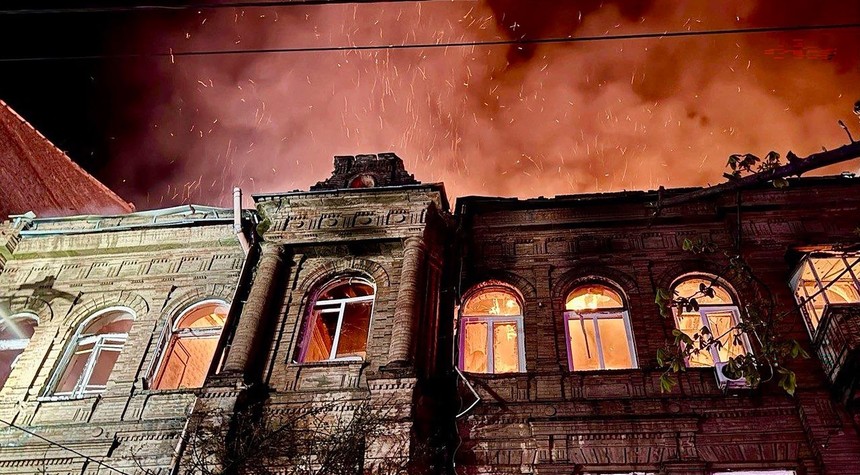
Russia unleashed one of its most extensive aerial bombardments against Ukraine this week, launching nearly 700 drones and 19 ballistic missiles in a sustained attack that killed at least 16 people and wounded approximately 100 others across the country.
The assault, which began Wednesday and continued into Thursday morning, represents a significant escalation in Russia’s ongoing campaign against Ukrainian population centers. Ukrainian President Volodymyr Zelenskyy reported that his nation’s defense forces successfully intercepted roughly 636 drones and several missiles, though he acknowledged with evident frustration that “unfortunately, not all” were stopped.
Among the casualties was a 12-year-old boy, a grim reminder that this conflict continues to exact its heaviest toll on innocent civilians. Deaths were confirmed in Odesa, Kyiv, and Dnipro, with the capital city of Kyiv bearing the brunt of the missile strikes. Residential buildings sustained damage from the projectiles that penetrated Ukraine’s air defenses, transforming apartment complexes into scenes of devastation.
The scale of this attack demands serious consideration from Western policymakers who may be contemplating any relaxation of pressure on Moscow. President Zelenskyy made this point explicitly, stating that Russia “does not deserve any easing of global policy or lifting of sanctions.” His assessment appears sound. A nation that launches 700 drones at civilian population centers has demonstrated its intentions with unmistakable clarity.
European Council President Antonio Costa condemned Russia’s deliberate targeting of residential areas as an attempt to “terrorize civilians.” The European Union pledged to increase pressure on Moscow, though the effectiveness of existing sanctions remains a matter of ongoing debate among Western allies.
Russia, for its part, reported that Ukraine launched its own drone offensive, claiming to have intercepted more than 200 Ukrainian drones targeting various Russian territories. At least one Ukrainian drone struck a port facility on Russia’s Black Sea coast, according to local officials. These Ukrainian strikes, however, represent defensive operations by a nation fighting for its survival against an aggressor that invaded its territory.
The international community faces a critical juncture. Russia’s willingness to launch such massive attacks on civilian infrastructure suggests that diplomatic overtures divorced from military reality will prove ineffective. President Zelenskyy’s call for defending Ukrainian lives “with all available means” while applying “pressure for the sake of peace with the same full force” reflects the unfortunate truth that peace negotiations succeed only when backed by strength.
The question before Western nations, particularly the United States, remains whether they possess the resolve to provide Ukraine with sufficient defensive capabilities to make such attacks prohibitively costly for Moscow. Half-measures and delayed assistance have allowed this conflict to drag on, creating the conditions for attacks of this magnitude.
As this war continues, the facts speak clearly. One nation invaded another. That same nation now launches hundreds of drones and missiles at apartment buildings where families sleep. The path to peace requires acknowledging these realities, not obscuring them with false equivalencies or premature calls for negotiations that would reward aggression.
Related: Two School Shootings in Turkey Leave Five Dead Within 48 Hours