
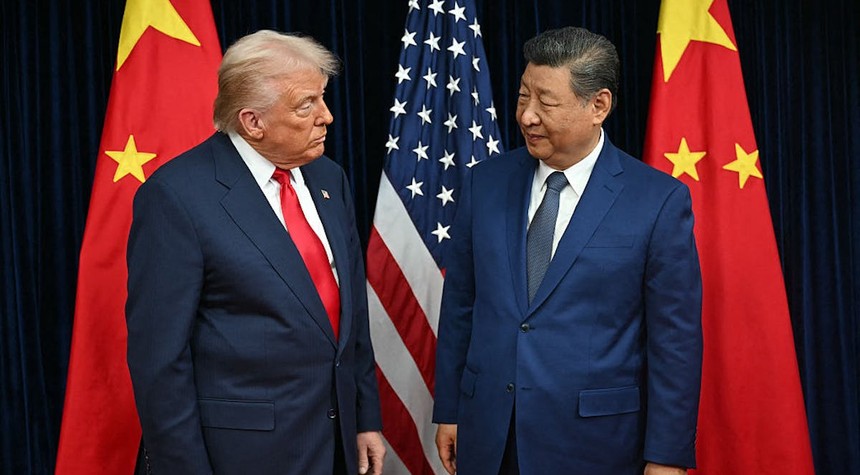
The shadows of great power competition have darkened once more, this time cast across a small air base in Jordan where three American service members lost their lives and four others sustained injuries in an Iranian attack that appears to have benefited from Chinese intelligence assistance.
President Donald Trump addressed the matter Sunday following reports that Chinese entities provided high-resolution satellite imagery of the Muwaffaq Salti Air Base in Jordan to Iranian forces prior to the strike. The president’s response was measured, noting the mutual reality of intelligence gathering between nations. “We spy on them, and China spies on us,” he stated, acknowledging the uncomfortable truth of modern statecraft.
The July 17 ballistic missile attack struck with devastating precision, targeting a housing area where American troops were sleeping. What troubles military analysts is not merely the tragedy itself, but the apparent improvement in Iranian targeting capabilities that made such precision possible.
The United States government has stopped short of accusing Beijing of direct involvement in the transfer of satellite imagery. When American officials raised their concerns with Chinese counterparts, they were met with demands for proof. Yet the structural reality of China’s economy makes such denials difficult to accept at face value. The Center for Strategic and International Studies notes that Chinese law requires many large companies to include Chinese Communist Party members on their boards, granting the state considerable influence over corporate decisions.
This is not a matter of China acting alone in supporting Iran’s military operations. Intelligence reports indicate that Russia has also provided Tehran with targeting information. The Trump administration maintains that foreign intelligence has not significantly enhanced Iran’s strike capabilities. However, recent events suggest otherwise.
For months following American and Israeli strikes on Iranian radar and intelligence facilities, Tehran’s targeting accuracy had notably diminished. That pattern appears to have reversed. Iranian forces now strike targets with a precision that demands explanation.
The answer may lie in artificial intelligence. Iranian proxies and cyber actors have begun employing artificial intelligence systems for reconnaissance, vulnerability scanning, and information operations. One major AI company, Anthropic, reported in September that it had thwarted Iranian attempts to misuse its technology for military purposes.
The relationship between Beijing and Tehran extends beyond satellite imagery. Researchers suspected collaboration on artificial intelligence technologies even before the current intensification of regional hostilities. The Trump administration has responded with sanctions against several Chinese satellite imagery firms for providing intelligence to Iran.
If China has successfully positioned its AI companies as providers of surveillance and targeting systems to Iranian forces, the implications extend beyond this particular conflict. The Iranian theater could serve as a testing ground where the Chinese Communist Party evaluates how its systems perform against American forces in actual combat conditions.
The economic ties binding China to Iran’s war machine run deep. The United States-China Economic and Security Review Commission has documented extensive connections between Chinese and Iranian defense industries, including the transfer of rocket fuel precursors and related materials.
What emerges from these interwoven relationships is a picture of coordinated adversarial action against American interests. Three American service members are dead, victims not merely of Iranian missiles but of an intelligence and technology network that spans continents. The question before American policymakers is not whether these relationships exist, but how to respond to them effectively while managing the complex realities of great power competition in an interconnected world.
Related: Saudi Arabia Faces Strategic Setback as Houthis Capture Key Red Sea Port