
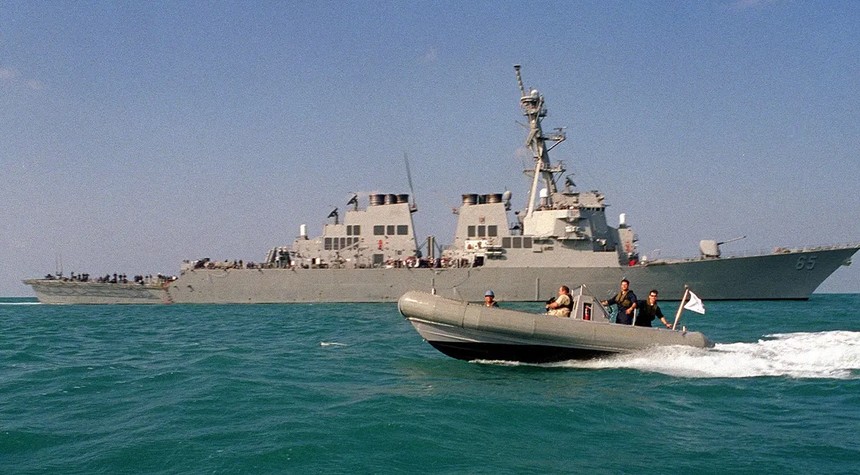
The United States Navy finds itself in a precarious position, stretched dangerously thin across global waters while facing mounting threats from adversaries who are watching, waiting, and calculating.
Retired Navy Captain Brent Sadler has issued a stark warning about the current state of America’s naval forces. The fleet, he argues, has shrunk to a point where it can no longer adequately counter the threats posed by nations such as China and Iran. This is not merely a matter of military theory or budget discussions in Washington. The consequences are real, immediate, and troubling.
Consider the USS Abraham Lincoln, whose crew endured a grueling 250-day deployment, far exceeding the traditional six-month standard that has long been the Navy’s benchmark for maintaining both operational readiness and crew welfare. This extended deployment serves as a symptom of a larger disease: there simply are not enough ships to meet America’s global commitments.
The situation grew more concerning last month when the USS Benfold, a guided-missile destroyer, suffered a complete power loss in the South China Sea. The warship sat dead in the water for four days following an engineering casualty involving its generators. The Navy was forced to tow the nearly 10,000-ton vessel to Subic Bay in the Philippines for emergency repairs.
Commander Matthew Comer, speaking for the U.S. 7th Fleet, confirmed the incident and praised the crew’s response, noting there were no injuries. Power was restored two days after arrival at port. Yet the praise for crew resilience, however well-deserved, cannot obscure the fundamental problem: a modern American warship was rendered helpless in waters where China increasingly asserts its dominance.
The power loss was not a minor inconvenience. It disrupted galley services, rendered toilets inoperable, shut down air conditioning, and cut off potable water supplies. The crew of the Benfold found themselves in a floating metal shell in tropical waters, unable to perform their mission and vulnerable in one of the world’s most strategically contested regions.
These incidents paint a troubling picture. The United States Navy, which has guaranteed freedom of navigation and underwritten global commerce since the end of World War II, is being asked to do more with less. Extended deployments strain both equipment and personnel. Ships break down when they are pushed beyond their designed operational limits. Crews grow weary when deployments stretch from six months to eight or nine.
Captain Sadler’s prescription is straightforward: build more ships. Restore the fleet to a size that allows the traditional six-month deployment cycle. Give America’s sailors the tools and the schedule they need to maintain readiness.
The question facing policymakers is whether they will heed this warning before a more serious incident occurs. China is building ships at a pace that far exceeds American production. Iran continues to threaten shipping lanes in the Middle East. The demands on American naval power are not diminishing.
The men and women of the United States Navy continue to perform with professionalism and dedication. They deserve a fleet sized to meet the missions they are assigned. America’s security may well depend on it.
Related: Ukraine Launches Massive Drone Assault on Moscow as War Escalates